
HubSpot Australia: Executive Report

The State of Business Growth in Australia 2025

56% of Australian businesses report that they are outperforming peers. What sets these growth leaders apart from the pack?


Executive foreword: Australia’s business leaders are driving growth through agility and operational excellence

Australia’s business landscape is defined by a powerful combination: a strong domestic market and proximity to fast-growing Asia-Pacific markets. But opportunity doesn’t guarantee ease.

Rising operational costs and persistent economic uncertainty are squeezing margins hard. There’s no time to stand still. Digital transformation is accelerating like never before, and agility isn’t just an advantage, but a business imperative.

I’ve observed Australian businesses sharpening their focus on operational efficiency and scalability as key strategies to tackle rising costs without sacrificing their competitive edge. Those investing in integrated systems and AI are already reaping tangible rewards—faster operations, lower expenses, and sustainable growth.

Strong leadership is essential. Those who can harness technology to streamline processes, steer transformation, and expand effectively will set themselves apart. 

To understand how Australian businesses are adapting to a shifting economic and business climate, we surveyed over 1,000 business leaders about their growth strategies, technology investments, and the challenges they face in 2025 and beyond. What we discovered reveals the practices and priorities that separate high performers from the rest—and where the biggest opportunities lie next.

Our findings highlight a clear divide: between those reacting to change and those leading change with technology. 

Megan Hughes, Country Head ANZ, HubSpot

Introduction

Australia's Business Growth Landscape

Based on a survey of 1,033 business leaders across Australia*, we gathered insights on growth opportunities, challenges, and key strategies for 2025.

Here’s what we found:

90% of Australian businesses have digitalised to some extent, but only 18% are fully digitalised, and 10% are minimally or not digitalised at all.
86% of businesses report that technology adoption has had a positive impact on productivity, and the same proportion see gains in customer experience. Larger businesses benefit most: 95% of those with over 200 employees report productivity improvements, compared to 73% of small businesses.
90% of businesses have some level of system integration, but only 18% are fully integrated. Those with fully integrated systems are almost 4x more likely to realise ROI from new technology within a month, and 77% report outperforming their peers, compared to those with minimal, partial, or no integration.

70% of businesses have implemented AI, but only 12% are at the advanced stage of implementation. This latter group is 4x more likely to report significant growth performance compared to those at moderate or early adoption stages.

56% of businesses say their growth performance is better than their industry peers. 14% even report they’re significantly outperforming them and growing at least 20% faster than average. 
Despite economic pressure, Australian businesses are seeing returns faster than anticipated—achieving ROI from tech investments in 4.4 months on average, compared to the 6.2 months they expected.

Australia's growth leaders: what sets them apart?

While many businesses are navigating uncertainty, some Australian businesses are pulling ahead. So what’s giving them the edge? They’re using a combination of smarter integration, digital innovation, and a sharp focus on customer experience to help them scale faster and more efficiently.  

The performance reality

Australian business leaders are feeling confident—56% believe they’re outpacing industry peers, and 14% say they’re significantly ahead, growing 20% faster than average. Just 8% see themselves as underperforming.

Strong performance isn’t just luck. One of the clearest indicators of outperformance is integration maturity. Businesses with fully integrated systems are over 6x more likely to report significantly outperforming peers compared to those with little or no integration, making it clear that integration isn’t just a tech investment, but a competitive strategy.

Marcus Cooper

After the devastating 2019-20 bushfires, WIRES had to grow fast—new teams, new services, and more than 1,000 volunteers across NSW. But that rapid growth also brought complexity. Teams built their own systems. Data lived in silos. We couldn’t scale that way. Using a platform like HubSpot let us unify everything into a single system, from our 24/7 wildlife rescue hotline to donor engagement and volunteer coordination. It’s helped us move from reactive chaos to proactive, sustainable scale.

Marcus Cooper

CTO

WIRES

The industries leading the way are information media and telecommunications (including tech and software), financial and insurance services, and manufacturing. Their lead isn’t coincidental—it’s directly tied to higher levels of digitalisation, system integration, and AI implementation.

Among these high-performing industries:

  • 100% of information media and telecommunications businesses are at least partially digitalised, 65% are mostly or fully integrated, and 76% have implemented AI at some level.
  • 97% of financial and insurance services businesses are at least partially digitalised, 78% are mostly or fully integrated, and 87% have implemented AI at some level.
  • 91% of manufacturing businesses are at least partially digitalised, 69% are mostly or fully integrated, and 87% have implemented AI at some level.

Across the board, businesses with higher levels of digitalisation, AI maturity, and system integration consistently report outperforming their peers.


What's actually driving growth in 2025?

Customer experience is the top growth driver in 2025, and 43% of businesses attribute their progress over the past year to CX.

Operational efficiency improvements (37%) and marketing and sales optimisation (36%) follow closely, while 31% point to new product or service development. This suggests businesses are aligning customer focus with efficiency and innovation to fuel growth.

By business size, here’s what’s driving growth:

  • Customer experience improvements (43%)
  • Marketing and sales optimisation (35%)
  • Operational efficiency improvements (33%)
  • Customer experience improvements (43%)
  • Operational efficiency improvements (42%)
  • Marketing and sales optimisation (36%)
  • Operational efficiency improvements (48%)
  • Customer experience improvements (41%)
  • Digital transformation initiatives (36%)

Operational efficiency improvements gain significance as a growth driver as the business size grows demonstrating how enterprise-level businesses are leveraging technology and integration to operate at scale.


 

chris maccan

At NOW Finance, we flipped our entire architecture from product-first to people-first. We needed a system that let us design every interaction around the customer, not the loan. That shift has been critical for building long-term trust as we scale across brokers, direct channels, and white-label partners. Having a unified platform to map complex relationships has been essential to launching new products, growing efficiently, and being truly customer centric.

Chris Maccan

CMO

NOW Finance

Key barriers restricting business growth

Economic uncertainty is the top growth barrier for 38% of Australian businesses, with some possibly feeling the impact of trade and tariff headwinds. Talent shortages — reported by 28% of businesses — are particularly acute in Australia, where a persistent skills gap is slowing growth. Limited funding (27%), slow decision-making (24%), manual inefficiencies (22%), and tech integration challenges (22%) also continue to hold back growth.

Barriers vary by business size, but economic uncertainty is a shared concern.
Economic uncertainty tops the list of challenges across all business sizes, with 38% of small, mid-market, and upmarket businesses citing it as a key barrier to growth.

Beyond that, growth barriers begin to diverge - here are the top barriers by business size:

  • Limited capital/funding (25%)
  • Talent shortages (25%)
  • Talent shortages (31%)
  • Limited capital/funding (30%)
  • Slow decision-making processes (30%)
  • Technology integration challenges (30%)
  • Talent shortages (32%)

While economic uncertainty remains the one constant across the board, the data shows a clear trend: growth barriers change as businesses scale. Smaller companies struggle with funding, mid-sized and large enterprises face deepening talent shortages, and larger enterprises contend with more complex technology challenges. 

Inefficiencies are holding back growth, despite digital readiness.

Australian businesses have the digital foundation, but struggle to execute at speed. For less digitally mature companies, manual inefficiencies (22%) are one of their top 3 growth challenges. Access to technology isn’t enough. What sets growth leaders apart is how they use it.

mark deacon

We had the strategy. We had the leads. But we didn’t have the speed. AI forced us to rethink how we operate. But here’s the thing: for AI to truly work, it needs context, and that only comes with connected systems and a unified tech stack. Having that in place has made our execution faster, smarter, and more scalable.

Mark Deacon

Chief Commercial Officer

Canibuild

Chapter 2

Operational excellence is the new competitive advantage in 2025

What sets successful businesses apart in 2025 is not just what they invest in, but how they operate:

  • Their systems deliver immediate value with faster-than-expected ROI timelines, making the ROI clear and compelling.
  • Their operations are integrated and efficient, eliminate manual handoffs, and reduce cost per transaction.
  • Their leaders prioritise efficiency and scalability over growth at any cost.

Fully digitalised businesses are nearly 2x more likely to prioritise AI implementation as a growth driver compared to those that aren’t digitalised.

Digital maturity plays a key role, too. Among those who report significantly outperforming their peers (by 20% or more): 

  • 43% are fully digitalised, compared to the average of 18%
  • 49% are fully integrated, compared to the average of 18%
  • 89% have implemented AI, compared to the average of 70%
  • 40% report advanced AI implementation, compared to the average of 12%.

The top growth priorities for those significantly outperforming their peers are implementing AI or automation technologies, expanding into new geographic markets, and enhancing customer retention and loyalty.

But it’s not just what they're doing, it’s how they do it. These businesses don’t invest in AI or expansion just for the sake of it. Instead, they weave these strategies into a unified, customer-centric approach that puts speed, execution, and measurable results first. That’s the difference between merely experimenting with growth and truly accelerating it.

Kat Warboys-Aug-27-2025-03-06-33-1916-AM

It's no secret AI has compressed years of innovation into months. In the conversations I've had with marketers across APAC, many of us feel overwhelmed by this rapid change. As leaders, we have the unique opportunity to encourage experimentation and embrace new technology to help solve business growth challenges, making teams AI-first without adding unnecessary complexity or additional tools with a whole new learning curve.

Kat Warboys

Senior Director, Marketing

HubSpot

Digital maturity and technology adoption in Australia

Australian businesses have made significant strides in digital adoption, but most are still on the journey to full digital maturity.

Australia's digital landscape: Strong start, clear challenges.

90% of Australian businesses are at least partially digitalised, but only 18% have reached full digital maturity. Another 39% are significantly digitalised, while a third are still in the early stages.

The impact of technology adoption

Where businesses have made digital investments, the impact is clear: 86% report improved productivity, with almost 1 in 5 businesses seeing a 20% or greater lift. 

Customer-facing benefits are clear, too: 86% of companies report technology has improved the customer experience, with 21% seeing significant gains.

Notably, larger businesses tend to see stronger results from technology adoption. While 90% of small businesses report productivity gains, this rises to 93% for mid-sized businesses and remains at 90% for larger enterprises - showing how scale and digital maturity can influence the impact.

jenny talbot

With more than 400 offices, communication, transparency, and visibility are essential at LJ Hooker. This was why we moved away from decades-old legacy systems to cloud-based tools that could scale without heavy customisation. A key goal was unifying communications, contract management, and performance tracking across our franchise network. But the real shift came from leadership - when your CEO is in the system daily and expects others to be too, adoption becomes embedded in the culture.

Jenny Talbot

GM Delivery and Procurement

LJ Hooker

Chapter 3

Integration as a growth accelerator

System integration is where efficiency, speed, and ROI begin to compound. While 90% of businesses have started integrating systems, only 18% are fully integrated - a gap with real consequences.

Fully integrated companies are 4x more likely to realise ROI from new technology investments within a month, compared to those with minimal or no integration. And beyond time to value, 77% of fully integrated businesses say they outperform their peers, suggesting a direct link between integration maturity and competitive advantage. 45% say they’re mostly integrated, and 28% are only partially integrated, leaving a significant portion of businesses stuck in the “in-between,” where fragmentation continues to slow execution and limit visibility.


System integration is where efficiency, speed, and ROI begin to compound. 

This pattern is also influenced by geography. Australian businesses operating in Asia (including Japan) and North America lead the way, with 30% saying they’ve reached full integration. This shows a stronger focus on long-term scalability and tech cohesion in those regions. 

Integration is so important as companies scale. Australian businesses are wasting $1.4B per year on digital tools they don't use as a result of disconnected systems.

While this data is from 2022, the number of systems being used by an average business has only gone up in the last few years as more AI tools enter the market.
Yet only 59% of companies report that their AI tools integrate well with existing platforms. The remaining 41% face significant integration challenges or have concluded their AI solutions simply don’t integrate well at all, creating fresh barriers to AI adoption.

Scott Brinker, webinar headshot-2

Tech adoption is a great first step, but it’s integration that truly unlocks growth. Integration is the bridge between potential and performance. What good is customer data if it’s isolated in one system or only accessible to one team? The companies that win have fully integrated systems that connect every part of the customer journey.

Scott Brinker

The integration advantage

Here’s what the success stories tell us: integration drives real results. Businesses with higher integration levels consistently report better growth performance. When systems connect well, teams stop chasing data and start using it, making faster, smarter decisions with real-time, accurate data while reducing delays, mistakes, and manual work.

As companies expand across regions, integration moves from nice-to-have to critical. Managing multiple markets quickly becomes complex, and integrated systems provide the visibility and consistency needed to respond quickly and stay coordinated.

Case Study: Azora Finance Group

Azora Finance Group faced operational chaos as they scaled rapidly in 2019, with no single source of truth for managing broker relationships, manual siloed sales processes, and limited visibility into deal flow and broker performance that hindered leadership decision-making at speed. The company needed infrastructure to support high-velocity growth while targeting $600 million in annual originations and a $1 billion loan book.

Azora implemented HubSpot as their comprehensive platform, creating a centralised command centre with Sales Hub, Marketing Hub, and Service Hub that seamlessly integrated with their proprietary origination system.

The transformation delivered remarkable results

  • 300% growth in their loan book
  • 75% reduction in loan approval times
  • 15% increase in conversion rates
  • 60% growth in their broker network

And they managed this growth while keeping the same team size. The unified platform eliminated operational bottlenecks and created a data-driven culture where all teams work from live data with complete visibility into performance metrics.

Azora Finance Group went from fragmented operations to 300% growth through system integration

Digital maturity and integration assessment

Ready to close your integration gaps? Use these frameworks to evaluate where you stand and what to prioritise:

  • Review your tech stack, workflows and cross-functional alignment and collaboration
  • Identify digital gaps across your customer joureny and manual processes that should be digitised
  • Compare your digital maturity against peers - only 18% of Australian businesses are fully digitised
  • Establish KPIs to track process automation, team adoption and decision velocity
  • Evaluate your team's current capabilities and identify upskilling needs.
  • Audit your current tech stack. Capture your current system landscape: marketing tools, CRMs, ERPs, financial platforms, and more. Identify overlaps, gaps, silos, which tools are in use and where workflows pass between them.
  • Identify integration pain points and areas where manual rework slows down execution
  • Set high-ROI integration goals and prioritise integrations that will deliver measureable ROI, like lead to revenue tracking, cross-channel automation or unified customer profiles.
  • Standarise your data frameworks so that marketing, sales and service can access accurate, shared information.
  • Create a governance framework - ensure consistent, secure and accurate data sharing guidelines across integrated systems. Assign ownership, set rules and track compliance.
  • Design for customer experience continuity - ensure every touchpoint is supported by connected systems for a cohesive customer experience.

Chapter 4

AI adoption and execution: where are Australian businesses?

The AI adoption landscape

70% of companies in Australia have started implementing AI in some form. But only 12% have reached the point of advanced implementation across multiple business functions. 

Most organisations remain in early or partial adoption stages. Around 31% have implemented AI, but only across select functions. Meanwhile, 27% are in the early stages, just beginning to roll out their first organisation-wide AI projects.

 
AI implementation expectations and outcomes

Even though AI adoption is still early for many, businesses have a range of expectations:

  • 38% see AI as a tool to reduce costs by automating repetitive tasks and improving workflows
  • 36% view it as a driver of revenue growth—shifting the focus beyond just cost-cutting
  • Improving customer experience through faster response times is important for 35%, especially as service expectations rise. The same share sees AI as a way to build competitive advantage
  • 33% expect it to help accelerate content creation, enabling teams to produce more at speed

AI’s reported benefits line up with expectations around speed and scale.

Increased efficiency (36%) and productivity (33%) remain the most common outcomes, highlighting AI’s role in making operations run faster and leaner. Financial outcomes like reduced costs (29%) and increased revenue (27%) are also taking shape. And with customer satisfaction improvements (27%) rounding out the list, it’s clear AI is beginning to drive impact across several business functions. 


While overall AI adoption is strong across Australia, implementation depth varies significantly by industry—revealing untapped opportunities for competitive advantage.

AI implementation by industry
% at advanced implementation
Financial Services

29%
IT & Telecommunications

21%
All sectors

12%
Kat Warboys-Aug-27-2025-03-06-33-1916-AM

We’re seeing a new kind of competitive edge emerge - and it’s being driven by AI. Among businesses that report significantly outperforming their peers, nearly 90% have implemented AI, and 40% are at an advanced stage of adoption, more than 3x the average. Just a year ago, our research found that while 51% of leaders were experimenting with AI personally, organisational adoption was lagging. That gap is now closing - fast. For smaller businesses, this levels the playing field. AI-powered tools for content creation, automation, and insight generation are giving leaner teams the kind of scale, precision, and speed that was once out of reach.

Kat Warboys

Senior Marketing Director

HubSpot

Navigating AI implementation challenges

AI adoption isn’t without its roadblocks. The biggest barrier is cost of implementation (31%), followed closely by a lack of technical expertise (29%) and concerns around security and privacy (27%).

Businesses also point to challenges with integration (24%) and data quality or availability (23%). Often, these challenges don’t point to flaws in AI but to the complexities of the systems it’s being introduced into. 

mark deacon

At Canibuild, we approached AI like hiring a new team member. We didn’t just roll out tools. We hired AI agents into the parts of the business that actually needed them. Then we onboarded them properly, trained them, reviewed their performance, and kept optimising. The difference is, once an AI agent is up to speed, it becomes a reliable partner—always-on, always ready to support our teams so they can focus on higher-impact work. Having an integrated system meant we could give those agents the full context they needed from day one. That mindset has delivered real gains in speed, customer experience, and scale for our business - for example, reducing our average first response time from hours to seconds.

Mark Deacon

Chief Commercial Officer

Canibuild

These hurdles become far more manageable in integrated environments, where unified systems reduce complexity, lower the need for deep technical expertise across multiple tools, and simplify security frameworks.
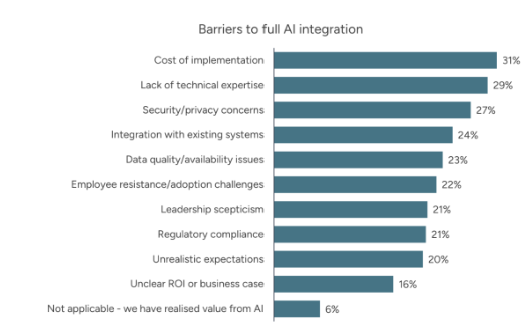

barriers to full ai integration

nicholas-holland

Getting real value from AI starts with good data. Structured CRM data is still just as important as ever. But AI also needs unstructured data- calls, emails, and meeting transcripts, where you hear your customer’s voice in their own words. That’s what takes AI from good to great. AI agents need context and connection. We’ve seen too often that isolated AI tools working on separate tasks get stuck in the same silos as traditional apps. For AI to make a real difference, these agents have to communicate and share insights across the entire customer journey.

Nicholas Holland

Head of AI, SVP Product

HubSpot

Best practices for fast, secure AI adoption

For leaders taking AI beyond pilots into strategic execution: 

Start with high-impact, cost-saving use cases: Begin your AI journey with one or two focused applications that reduce costs and show quick, measurable wins—like automating routine support queries with Customer Agent or drafting outbound emails. These early successes build confidence, demonstrate value, and create internal momentum for wider adoption.

Ensure data quality and system integration before AI deployment: Before implementing AI tools, ensure your core business systems can share data effectively and accurately. The smartest AI needs connected, contextual data from across your CRM, marketing, sales, and service touchpoints.

Target operational efficiency gains before revenue-focused applications: Build a strong foundation for AI adoption by tackling inefficiencies first—this creates the stability needed to scale more ambitious, revenue-driving use cases later. 

Embed privacy from the beginning: Design your AI implementation and processes around “Privacy by Design” principles. Make consent, transparency, and security non-negotiables from day one, and clearly communicate your approach to customers and teams.

Build internal expertise through strategic partnerships: Close capability gaps by working with trusted partners who can help guide implementation, upskill your teams, and accelerate time to value.

Best practices for AI implementation

Chapter 5

Technology Investment and ROI

Technology ROI: expectations vs reality

Technology investments are only worthwhile if they deliver real, measurable returns. And businesses are seeing the benefits of their technology investments sooner than anticipated. While the average business anticipated a 6.2-month ROI window, the reality is closer to 4.4 months, which means that Australian businesses are seeing value faster than anticipated.

In fact, more than half expect returns within six months:

  • 30% expect ROI within 2–3 months
  • 26% expect ROI within 4–6 months
  • 18% expect ROI within 7–12 months

Businesses with higher digital maturity, however, are seeing significantly faster returns on their technology investments. For fully digitalised companies, 64% achieve ROI in under three months - well ahead of the average 4.4-month timeframe across all businesses.

Similarly, businesses with advanced AI implementation are experiencing even quicker returns, with 68% seeing ROI within three months - again outpacing the overall average.

Expectation

Reality

HubSpot users are 41% more likely to see value within one month, compared to users of other CRM platforms.

Why? Fast onboarding, easy workflows, and unified customer data create results from day one.

Technology investment priorities

Australian businesses are taking a diversified approach to their tech investment priorities. 

CRM systems lead the way, with 29% of businesses identifying them as a top investment priority. But priorities are spread across a range of technologies:

  • 28% of organisations prioritise generative AI tools.
  • 26% of organisations prioritise data analytics/ business intelligence tools.
  • 26% of organisations prioritise cybersecurity/data protection tools. 
  • 25% of organisations prioritise productivity and collaboration software.
 
Technology and government: What businesses are asking for

When asked what they want from new or returning government representatives on business technology, Australian businesses surfaced several clear priorities:

  • 43% want increased tax incentives for technology investments, while 39% seek a stronger emphasis on workforce upskilling to help close skills gaps.
  • One-third (33%) expect greater investment in AI and digital transformation, and
  • 31% want national regulation on AI adoption to provide clearer guidance as businesses navigate this evolving landscape.


How business size drives priorities for government tech support

Australian businesses’ priorities for government support on technology vary slightly by size, but some themes stand out. Small businesses lead in wanting tax incentives, mid-market firms show a balanced demand for tax breaks and digital upskilling, while upmarket organisations prioritise workforce upskilling and balanced investment incentives.

Government resources for Australian businesses

Chapter 6

Future growth priorities & market expansion

Top growth priorities for the next 12 months

Australian businesses are looking inward and outward as they map out their next phase of growth. Operational efficiency tops the list, with 33% of businesses making it their main growth priority.

Customer retention (31%) and reaching new segments (28%) follow closely, suggesting a strong push to strengthen existing relationships while expanding reach. Improving sales processes (27%) and investing in AI or automation (25%) also rank high as businesses gear up for scalable growth.

What's needed to connect businesses with their next phase of growth?

For many, it starts with people and policy. Upskilling employees for digital transformation is the top priority (44%), followed closely by a call for stronger government support (42%). Businesses are also looking to accelerate growth through increased AI adoption (34%), better market intelligence (31%), and more unified systems to cut down inefficiencies (28%).


But not every company needs the same resources to grow. Here are the growth resources those outperforming and underperforming against their peers prioritise as important to them.

For companies outperforming:

  • stronger government incentives and support [50%]
  • Increased AI adoption and automation tools [49%]
  • Upskilling employees for digital transformation [46%]

For companies underperforming:

  • Access to better market intelligence [62%]
  • Increased AI adoption and automation tools [49%]
  • Upskilling employees for digital transformation [38%]


Impact of the global economic climate 

The global economy is influencing local decision-making. While 58% of Australian businesses are being more cautious with their growth approach in response to global uncertainty, a smaller but significant 12% are taking the opportunity to be more aggressive, showing that bold strategy still has a place in challenging times. The remaining 30% are sticking to their current course. 


Market expansion challenges

Despite strong appetite for growth, Australian businesses are navigating real barriers to market expansion. Competition from established players (30%) and entry costs (29%) are the biggest challenges, but many also cite economic uncertainty (25%), supply chain complexity (22%), and the need for better customer insights/market intelligence (21%).

Case Study: BruntWork

BruntWork
needed to rapidly scale their remote outsourcing business across multiple industries, countries, and languages while onboarding 2-300 people monthly. They required a CRM platform that could grow quickly, provide transparency for global decision-making, and avoid the prohibitive costs and complexity of their previous Salesforce system.

The BruntWork team implemented HubSpot as their single source of truth, enabling them to scale to 2,500 staff across Australia, Colombia, Serbia, Ukraine, and the Philippines with clients in 14+ countries, reaching $50 million in recurring revenue within three years.

“A lot of the success is because of the technology - we run multiple teams with a single source of truth, easy training and simple upskilling which is exactly what you need when you’re bringing on 2-300 people a month,” says Adam Pisk, Chief Revenue Officer at BruntWork.

The platform's ease of use created a streamlined 2-week onboarding process for new staff, while comprehensive analytics enabled strategic pivots including refocusing 70% of new business toward North American markets based on data-driven insights tracking the entire customer lifecycle from keyword performance to lifetime value.

BruntWork scaled global remote operations to $5M+ MRR through technology integration

Closing

Navigating Australia's growth landscape in 2025 and beyond

Operational efficiency isn’t just a goal. In 2025, it’s the driver of growth for leading businesses.

Those prioritising integrated systems are dismantling data silos, streamlining workflows, and enjoying faster, smarter decision-making, leading to faster returns on technology investments and a strong competitive advantage.

For many businesses, the real advantage of a unified platform isn’t just faster execution, it’s the ability to plan growth with confidence.

Ignoring the benefits of operational efficiency is no longer an option for businesses aiming to lead. AI adoption is accelerating, but without clean, connected data and tightly integrated systems, its potential will stall. 

The challenge is clear: balance bold growth ambitions with operational discipline. Those willing to modernise, integrate their technology stacks, and embed efficiency into the heart of their operations will not only thrive, but set the pace for the next wave of growth.

While the demand for stronger government support around technology and workforce development would be helpful, the responsibility lies with business leaders to seize the moment.

That moment to act is now: integrate systems, use AI with intention, and lead with operational excellence—before the opportunity passes.

jenny talbot

We always knew the sales cycle was long, but we didn’t know how long. Having that visibility changed the conversation. It gave us the ability to tell the story to stakeholders, wrap it in real data, and plan with confidence. Now we can model pipeline health with more precision and understand what it really takes to hit our growth targets.

Jenny Talbot

GM of Delivery and Procurement

LJ Hooker

Growth framework amidst economic uncertainty

Double down on what works: Focus on tools and workflows that deliver quick, measurable returns.

Build an agile tech stack: Connect your systems to eliminate silos, reduce handoffs, surface data in real time, and move faster under pressure.

Design for resilience and scale: Use flexible frameworks and automation to adapt quickly and without driving up costs.

Make every customer count: Use integrated data to personalise every support, marketing, and service touchpoint and build loyalty that lasts.

Lead with data clarity: Real-time insights empower confident decisions and separate the reactive from the resilient.

Partner to go further: Develop relationships with like-minded businesses to share resources and broaden your reach.


multimedia callout image

A sustainable growth framework amidst economic uncertainty

Ready to explore what's possible?

HubSpot's Breeze helps businesses achieve the integrated operations and AI capabilities highlighted in this research.