Creator Offer: Jade Bonacolta

5 Steps to Command Any Room

Executive presence isn’t about being the loudest in the room—it’s about quiet confidence that commands attention. In Jade's 5-step handbook, learn subtle, high-impact habits like mastering the pause, listening beneath the surface, and leading with clarity to earn trust, influence, and respect.

Explore HubSpot's AI-Powered CRM, designed to turn creative AI ideas into automated workflows across marketing, sales, and service.

I spent years studying the people who get the promotion, the board seat, the loyalty of entire teams. They weren’t the loudest, and yet they commanded every room. People leaned in to better hear what they said.

And I realized: almost everything we've been taught about executive presence is outdated.

The old model told us to speak up first. Take up space. Project confidence. Have a "power stance." That model was built for a world where leadership meant broadcasting—where the person who talked the most won. That time has passed.

The leaders who thrive now practice something fundamentally different: Quiet confidence.

This is the handbook I wish someone had handed me ten years ago.
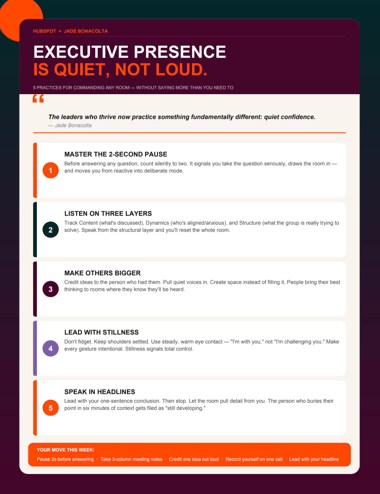
Jade Bonacolta's 5 Steps to Command Any Room

Want this handbook for easy reference? Here's the downloadable PDF of Jade's 5-part handbook so you can print it, annotate it, and reference it before your next high-stakes meeting.

PDF version of her command any room 5-step handbook

7 Steps to Command Any Room

a leader commanding the room

Part One

Master The 2-Second Pause

The highest-leverage executive presence skill is one that looks like nothing at all: the pause.

Most professionals are terrified of silence. In a meeting, someone asks a touchy question, and the race begins. Who can fill the silence first? We've been conditioned to believe that a fast answer signals competence. But it often comes out rushed.

Watch a seasoned executive handle a hard question. There's a beat. Sometimes two or three seconds. Sometimes longer. They might repeat part of the question back. And when they do respond, it lands with more weight because the response has substantial thought behind it.

The pause does three things simultaneously.

  • First, it signals that you take the question seriously enough to properly consider it.
  • Second, the room leans in to hear what you’re going to say next.
  • Third, it regulates your own nervous system. A pause is a micro-reset. It moves you from reactive mode into deliberate mode. And deliberate is where presence lives.

Watch a seasoned executive handle a hard question. There's a beat. Sometimes two or three seconds. Sometimes longer. They might repeat part of the question back. And when they do respond, it lands with more weight because the response has substantial thought behind it.

Jade-2
Jade Bonacolta

Founder of The Quiet Rich

Customer_Platform_Illustrations_Color_LightBG

Part Two

Listen For What's Not Being Said

The #1 communication problem today is that we listen to reply, not to understand. The most underrated leadership skill is listening. And I don't mean the standard advice about "active listening" where you nod and paraphrase. I mean structural listening. Listen for what's underneath the conversation.

In any meeting, there are at least three layers happening at once:

  • The Content Layer: The actual topic being discussed.
  • The Dynamics Layer: Who's aligned with whom, who's anxious, who's checked out, what political undercurrents are running.
  • The Structural Layer: What question is this group actually trying to answer, and are they even asking the right one?

Leaders with quiet confidence operate on all three layers simultaneously. When they do speak, they often ask questions about the structural layer, and it's electrifying. They're the person who says, "I think we've been debating the timeline, but I want to make sure we agree on the goal." That single sentence can course-correct a 60-minute meeting. And it only comes from listening deeply enough to hear what's not being said.

contact-us-illustration-crop

Part Three

Make Others Bigger

Here's the most counterintuitive piece of the handbook: the leaders with the strongest presence spend most of their time strengthening the presence of others.

They ask the quiet team member for their perspective. They attribute ideas accurately: "That was Sarah's idea. Sarah, why don’t you walk you through it." They create space instead of filling it. They run meetings where the best idea wins, not the loudest voice.

When you consistently elevate others, people trust you because you're not in competition with them. You become the person everyone wants in the room.

The old model of executive presence was about individual magnetism. The new model is about collective intelligence, and being the rising tide that lifts all ships.

Jade-3
Jade Bonacolta

Founder of The Quiet Rich

Sales Deal_Illustrations_Color_LightBG

Part Four

Lead With Stillness

There's a version of body language advice that tells you to power pose, take up as much space as possible, and dominate with eye contact. That's the loud model. It reads as performance — and people feel it.

Quiet physical presence is different. It's about stillness. The leaders who command a room physically don't fidget. They don't shift their weight. They make eye contact that's steady without being aggressive—the kind that says "I'm with you" rather than "I'm challenging you."

Three physical habits separate leaders with quiet presence from everyone else.

  • First, they keep their shoulders settled and their posture open without puffing up. It's relaxed confidence, not a military stance.
  • Second, their gestures are intentional — they use their hands to reinforce a point, not to burn nervous energy. Every movement means something, so people watch more closely.
  • Third, they make eye contact when speaking, not just listening. Most people look at someone when they're talking, then let their eyes drift when it’s their turn. Warm eye contact is one of the most powerful nonverbal signals of respect, and people feel it immediately.

part 5

Speak in Headlines, Not Essays

Most professionals lose their audience not because their ideas are weak, but because they bury them. They open with context, layer in caveats, add a detour about process, and finally arrive at the point, by which time the room has mentally moved on. Leaders with quiet confidence do the opposite. They lead with the conclusion. One sentence. Clear and direct. Then they stop and let the room pull more from them if it's needed. This is headline-first communication, and it's ruthlessly effective because it respects the room's attention.

Think of it this way: in a meeting of senior people, everyone's mental bandwidth is limited. The best speaker can distill a complex issue into one sharp sentence. The person who takes six minutes to get to the point, no matter how smart they are, gets mentally filed as "still developing."

Service Agent_Illustrations_Color_LightBG

Every single one of these practices is about creating a little more space before you respond: The pause before you answer. The listening before you contribute. The elevation of others before you claim the spotlight.

It’s about focusing less on how you're perceived and more on the value you're creating for others.

If this shifted how you think about executive presence, share it with your team. The best organizations aren't built by lone leaders with a big presence. They're built by teams where everyone practices showing up with intention.