MFM

How A $5B Founder Uses AI: 3 Tutorials

The CEO of Zapier uses AI to make sharper decisions, design better days, and hold himself accountable. Here are his step-by-step tutorials - we took notes so you don't have to.

HubSpot's free CRM unifies all your customer data on one platform, with AI that makes it easy to understand.
LP Image - Finding Market Opportunity-1

Why You Should Care

Wade Foster bootstrapped Zapier to $5B. One round of funding, ever. The guy built the connective tissue of the internet and still runs it.

He came on MFM once before and showed us the AI agents his team built inside Zapier — real workflows, but you needed to be in their stack to use them. This time he's back with the prompts he actually runs himself. Claude, ChatGPT, whatever you've got open. No new tools, no setup.
01

The AI That Argues Back

Why does it matter to have AI push back on you? 

AI is a goal-seeking entity

Tell it what you want, and it will try to give that to you. If you don't tell it to push back, it won't. It'll just agree.

You won't always have the right people

Not every leader has a team that's comfortable telling them they're wrong. This fills that gap.

Arguing with AI is easier

Wade noticed his team engaged more critically when the AI surfaced the challenge — not him. The dynamic shifts.
wade-terminal-block

See It in Action

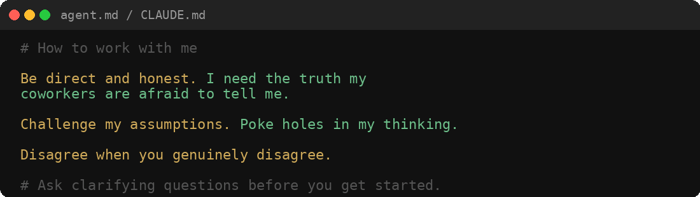
  • Wade uses Cursor. He added a "How to work with me" instruction file in AGENT.md
  • Default ChatGPT will tell you you're brilliant. Wade's is configured to do the opposite.
"I'm thinking we should kill our entire free tier this quarter because one of our competitors raised prices. Help me draft the announcement."
LP Image - Finding Market Opportunity-1

If you don't make this configuration, it's going to try to placate you because it thinks that's what you want. These things are goal-seeking entities. You have to tell it what goal you actually want.

Wade Foster

CEO

Zapier

02

The 7-Person War Council

For big decisions, Wade assembles a council of seven AI sub-agents — each playing a distinct persona and pushing from a different angle.
8-png-2

3 Standing Members

  • Wartime COO: Executes under pressure. Cuts through ambiguity. Owns accountability when things go sideways.

  • Ruthless CFO: Unit economics. Cash flow. Will the numbers actually work, or are we fooling ourselves?

  • Contrarian Board Member: The one who always asks: what are we missing? Why might this decision be wrong?

+4 Dynamic Members: Wade leaves four seats open. Based on the prompt, the AI decides who else needs to be in the room: a customer expert, an employment lawyer, a competitor's CEO — whoever fits the decision.

How to Use It

1. Ask AI to build the War Council

Prompt: "I want to set up a War Council — 7 sub-agents who stress-test my decisions. Generate 3 standing members: a Wartime COO, a Ruthless CFO, and a Contrarian Board Member. Define each persona in detail."

2. Give it a real decision

Prompt: "I'm considering hiring [role]. Here are my interview notes: [paste]. Run this through the War Council. Each member should weigh in from their perspective."

3. Let it generate the 4 dynamic members

For each new prompt, the AI picks who else belongs. A hiring decision might pull in an employment attorney and a culture expert. A pricing call might add a competitor analyst.

Real Example

Wade runs every offer approval at Zapier through the War Council. Here's what changed:

Before AI

  • Wade had a gut feel something was off with a candidate.
  • He'd tell the hiring panel, but couldn't always articulate why.
  • Panel heard it as: "The CEO doesn't want to hire this person."
  • Conversation became about Wade's opinion, not the candidate's fit.

After AI

  • War Council reviews the panel's notes and flags what wasn't scrutinized.
  • It scores the candidate against past hires at Zapier.
  • Wade brings it to the panel: "The AI flagged this. I agree — what's your take?"
  • Panel engages with the specific point, not with Wade's authority.

LP Image - Finding Market Opportunity-1

Maybe it's easier to argue with AI than with the CEO. Or maybe because it's more eloquent. I'm not sure, but the way we make decisions around hiring got better in part because we added AI to the loop.

Wade Foster

CEO

Zapier

03

Good Day / Bad Day Life Coach

How it works:

1. End of day trigger

AI loops over your meeting notes, to-do list, and open emails from the day.

2. The one question

"How did today go?" — you say good day or bad day, and why. That's it.

3. Immediate value

It drafts follow-up emails and actions you mentioned. Two hours of end-of-day admin → 15 minutes.

4. The 90-day pattern

Ask: "What do my good days have in common? And my bad days?" It knows, because you've been logging.

5. Hand it off

Give that pattern summary to your executive assistant. Protect the hours that matter most.

LP Image - Finding Market Opportunity-1

I used to spend like two hours at the end of my day just trying to catch up on every little ticky-tack thing that I got roped into. And now that two hours is down to like 15 minutes. It's so much better.

Wade Foster

CEO

Zapier

Bonus

Wade's AI Cheat Sheet

Prompting tips, observations, and predictions.

12-png-1

Prompting Principles

  • Meta Prompting: Ask the AI to generate the prompt for you. Describe what you want to accomplish, then say: "What's the best prompt I could give you to get there?" You can't out-prompt the software that sees all the prompts
  • Use Voice Dictation: Wade uses Monologue. Voice lets you give the AI a ton of context fast. You can have a strategy conversation while walking, without typing a word.
  • Warm It Up First: "Succinctly describe back to me what's in this doc." Then: "Be 100x more specific." These two prompts commit context into the AI's memory before you ask the real question. Better context → better output.
  • Make It Ask You Questions: End your prompt with: "Ask me anything before you get started" or "Tell me if there's more info I can give you." The AI knows what it needs. Let it ask.
4-Dec-19-2025-03-36-25-1222-PM

Observations Worth Sitting With

  • You're "hiring" AI as engineers: Cursor, Claude Code, Codex — Wade's tips work for any of these tools. He uses Cursor as his primary daily agent and doesn't write code. His framing: you're not operating a tool, you're managing a hire. You've probably worked with engineers before. You tell them "go build this." That's it. Same thing here. You're the manager. It's on your team. 

  • At some point, AI becomes the boss: "If you do a good job of building these tools up, they'll kind of start telling you what to do. By and large, I think these things make pretty good bosses for certain use cases." Keep your brain on — but don't be surprised when AI starts managing up.

  • Hook up your institutional knowledge: An AI that only knows the internet is generally smart. An AI that knows your company — every code commit, every customer conversation, every thread on Reddit or X about your product — is a different thing entirely. Hook up all of that and it can reason over more information than any human CEO ever could. 

  • Personality is the next axis of competition in software: Wade uses Monologue over Wisper Flow for one reason: it gets him. Just a vibe. His prediction: when software is so cheap to build, the differentiator stops being functionality and starts being personality. The same way you pick a jeans brand or a coffee shop. Anthropic and OpenAI already have two distinct personalities. The ones that figure out how to build genuine character into their products will win on feel, not specs.