Distribution fails before the first tactic gets tested. The failure point is usually sequencing: someone picks a channel, posts consistently for six weeks, and measures nothing because they never defined what success looked like or built a system to repeat what worked.
This playbook is built to prevent that.
Work through it in order the first time. The sections are sequenced deliberately: ratio before tactics, owned versus rented before format-specific checklists, foundational growth logic before AI shortcuts. Skipping to the checklist for your format without reading Sections 1 and 2 is like optimizing a funnel that points at the wrong destination.
After that first pass, the playbook works as a reference. Each section stands alone. The AI prompts are functional tools, not illustrative examples. Drop your actual numbers and context into them and run them.
The 12-Week Distribution Worksheet in Section 6 is the only fill-in section. Complete it before week one starts. Everything else works as operational reference you return to as your distribution system matures.
Web Guide
Content Distribution Playbook
Everything you need to build a repeatable content distribution system — with format-specific checklists, channel mapping tools, and a 12-week distribution plan you can start this week.
Turn more traffic into qualified leads with HubSpot’s Marketing Hub—powered by AI, automation, and built-in reporting that connects every campaign to revenue.
Section 1: The 80/20 Rule
Most content budgets are backwards. Production gets the calendar blocks, the Figma files, the review cycles. Distribution gets whatever time remains, which is usually not much. A well-produced newsletter sitting in 200 inboxes is a production success and a distribution failure.
The fix is a ratio shift before anything else changes. 80% of your weekly content effort goes to distribution. 20% goes to creation. That does not mean publishing less. It means the work of getting content in front of people gets treated as the primary job, not the cleanup task after publishing.
The practical implication: distribution is not one task. It's a stack. Native posts on multiple platforms, personal outreach, subscriber swaps, repurposed clips, community shares. Each of those is a discrete weekly action, and none of them happen automatically. They require scheduled time with a clear owner.
Audit your current week before building anything new. Log actual hours split between creation and distribution. The gap between where you land and the 80/20 target is your first action item.
I produce [content format] on a [cadence] schedule. Here is how I currently spend my content-related hours each week: [describe tasks and rough time per task]. Identify where I am over-investing in creation and under-investing in distribution. Flag any creation tasks I could consolidate or reduce without meaningfully affecting output quality. Recommend three specific distribution tasks I can add this week using the time recovered, and estimate the time each requires.
I currently spend approximately [X hours] per week on content creation and [Y hours] on distribution. My content format is [newsletter /
podcast / YouTube channel] and I publish [cadence]. Map out what an 80/20 distribution-to-creation week looks like for my format at my publishing frequency. Be specific: name the actual distribution tasks, how long each takes, and what day of the week each should happen.
Assume I am doing this without additional headcount.
Here are all the distribution tasks I am currently running or considering: [list tasks]. My content format is [format], my current audience size is [number], and my primary owned channel is [email / SMS / other]. Rank these tasks by expected impact at my current stage. Cut anything that is low-leverage given my audience size. Tell me what to stop doing, what to start doing, and what to keep.
Section 2: Owned vs. Rented
A social following is a lease. The platform sets the terms, adjusts the algorithm, and can cut your reach before your next post goes live. Email is a deed. You own the list, the send, and the relationship.
This is not an argument against social media. Rented channels are where discovery happens. The problem is treating them as the destination rather than the pipeline. Facebook's 2018 algorithm change wiped out organic reach for thousands of publishers who had spent years building page followings. The ones who survived had email lists. The ones who didn't, started over.
Every rented channel has one job: feed the owned one. A LinkedIn post, a podcast clip, a YouTube Short. Each is a conversion mechanism. The metric worth optimizing against is not likes or follower count. It's how many of those people ended up on your list.
Before building any distribution plan, map your current channels into two columns: owned and rented. Owned is anything you control directly, email, SMS, a community you host. Rented is any audience that lives inside someone else's product. The ratio between those two columns tells you where your dependency risk sits, and for most marketers, the ratio is more lopsided than they expect.
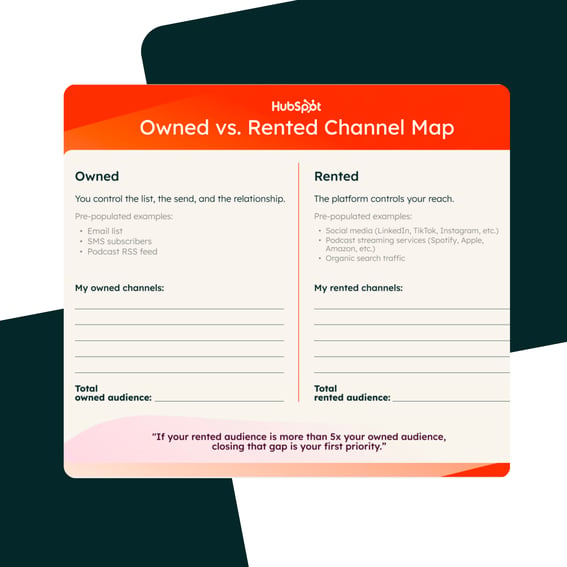
Owned vs. Rented Channel Map
Find out if you actually own your audience — or just borrow it. This channel map helps you see exactly where you stand between owned and rented channels, so you know where to focus your growth efforts.
Here are my current distribution channels and their audience sizes: [list channels and counts]. My primary owned channel is [email / SMS / other] and my current lead magnet or subscription offer is [describe it, or write "none"]. Identify which rented channels have the strongest conversion potential to owned audience at my current stage. For each, recommend one specific CTA or conversion mechanism I can add this week, and flag whether my current subscription offer is strong enough to convert at that placement. If it isn't, tell me what to change. Keep recommendations realistic for a team of [size].
I am trying to convert [platform] followers into email subscribers. My current subscription offer is [describe it, or write "none"]. My content covers [topic] and my target audience is [description]. Evaluate whether my current offer is specific enough to convert at this placement. If it isn't, write three alternative subscription offers that are more specific, more immediate in their value, and more likely to convert a cold audience who has only seen one or two pieces of my content.
Here are the social and third-party platforms where I have an audience, along with their current follower or subscriber counts: [list platforms and counts]. For each platform, estimate what percentage of that audience is likely to see any given piece of content based on typical organic reach rates. Then calculate the gap between my total follower count and my actual reached audience. Use that gap to prioritize which platforms deserve continued investment and which ones I should deprioritize or cut.
Section 3: Format-Specific Distribution Tactics
The tactics that grow a newsletter do not translate cleanly to a podcast, and a YouTube growth strategy requires different mechanics than either. Running the wrong playbook for your format wastes weeks. Find your format below and treat it as your weekly operating standard.
1. Newsletter
Publish natively on at least one platform per week, LinkedIn, Substack, or Medium, with a subscribe CTA in the final paragraph. Native content outperforms link posts on every major feed. The CTA does not need to be elaborate. One sentence and a direct link is enough.
Subscriber swaps are the highest-leverage growth tactic available to newsletter operators under 10,000 subscribers. Identify three to five newsletters in adjacent categories with comparable audience sizes. Pitch a mutual feature: you recommend their newsletter to your list, they do the same. One swap per month compounds faster than most paid acquisition at this stage.
2. Podcast
Every episode should produce at least one social clip before it publishes. The clip that converts is not always the clip that gets the most views. Optimize for the moment that makes someone want the full episode, not the moment that performs well in isolation.
Build a guest asset kit and send it before the episode drops. Include the clip, three to five suggested captions at different lengths, and the episode link. Guests with a ready-to-post package share at a significantly higher rate than guests who receive a link and a thank-you.
3. YouTube
Title, thumbnail, and first 15 seconds function as a single unit. A strong thumbnail with a weak title loses clicks. A strong title with a weak first 15 seconds loses watch time and tanks algorithmic distribution. Review all three together before every upload.
Collaborations are the fastest organic growth lever on YouTube. Productive collab mechanics: both channels produce one video that lives on the other's channel, with a clear CTA back to the host. Audience overlap of 30 to 50% tends to produce the strongest subscriber conversion.
I publish a [newsletter / podcast / YouTube channel] on a [cadence] schedule. My current subscriber count is [number] and my primary owned channel is [email / SMS / other]. Give me a specific weekly distribution checklist for my format and stage. For each item, include the estimated time required and whether it needs to happen before, on, or after publish day. Assume no additional headcount.
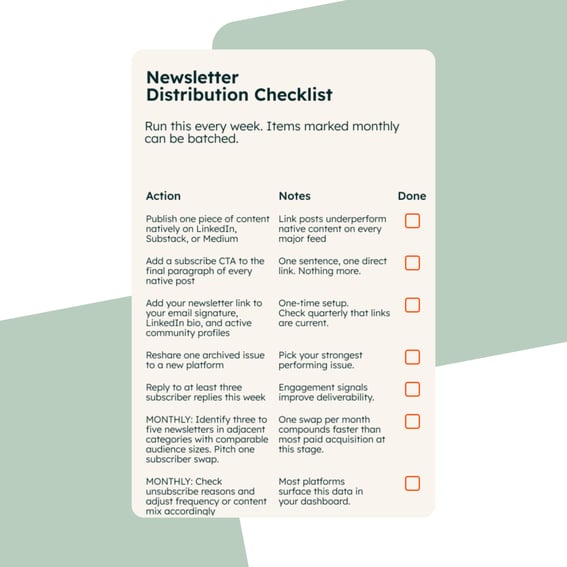
Distribution Checklist
Section 4: The 0 to 1,000 Plan
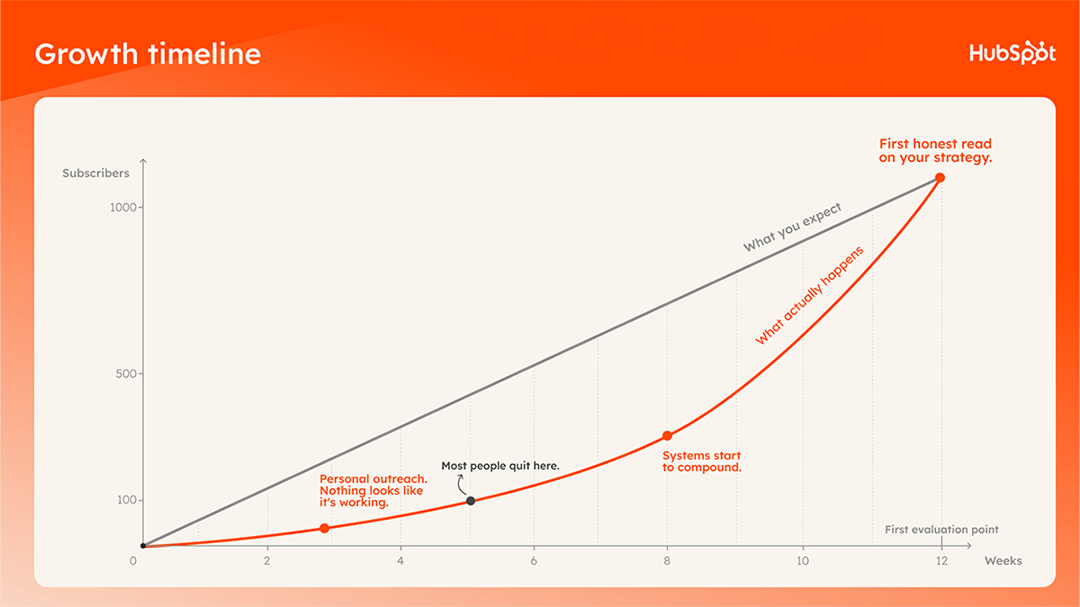
The first hundred subscribers do not come from a system. They come from you.
Direct messages to people you already know. Posts in communities where your audience already reads. Individual asks with a specific reason to subscribe now, not a link drop with a generic pitch. Ten personal contacts per week is the target. The subscribers you earn manually in this phase tend to be the most engaged ones you will ever have, because they subscribed because of you, not because of an algorithm.
There is no shortcut here. Trying to automate this phase burns the credibility that makes the next phase work.
Around 100, the mechanics shift. A subscriber swap lands differently when there is an archive to point to. A collab partner says yes more readily when the numbers show a pattern. Systems start to compound in ways they cannot when you are starting from zero. Consistency becomes the primary variable, and the channels that grow past 1,000 are almost always the ones where the operator kept going during the weeks nothing seemed to be working.
Give any new distribution system 12 weeks before drawing conclusions. The difference between a slow start and a wrong strategy is not visible at week six. Set a review date before week one begins and do not move it.
"Based on the ranking, feasibility check, and differentiation check above, recommend the 1 to 2 campaigns I should commit to. For each: write the concept in one sentence, name the primary channel, state the budget required, identify the metric I'd use to call it a win or a loss at 90 days, and flag one decision I need to make before kickoff."
Section 5: AI for Distribution
AI handles the mechanical work well. A 2,000-word newsletter becomes a LinkedIn post, a short-form script, and five subject line variants in under three minutes. Reformatting, adapting tone for platform, generating variations. That is real leverage, and most marketers are not using it consistently enough to feel the compounding effect on their weekly workload.
The ceiling is clear though. AI cannot write the subscriber swap pitch that lands because it knows the other newsletter's voice and audience. It cannot send the DM to a collab partner that converts because it has context on the relationship. It cannot write the reply that turns a casual subscriber into an advocate because it was not in the original conversation. The relationship work stays in your hands. AI handles everything that does not require one.
The prompts below cover the highest-leverage mechanical tasks. Build them into a repeatable weekly workflow rather than running them ad hoc.
Section 6: 12-Week Distribution Worksheet
This worksheet is where the system gets concrete. Fill it in before anything goes live. Part 1 locks in your format, anchor channel, and goal. Parts 2 and 3 map your channels and assign weekly actions so distribution runs on a schedule. Parts 4 and 5 track whether your outreach and rented channels are actually converting to owned audience. Part 6 holds your three check-in dates. Set them now and do not move them.
The running log in Part 7 is where most people fall short. Update it in real time. The pattern that's invisible week to week becomes the brief for your next 12-week plan, but only if you logged it.
Twelve weeks is the minimum honest commitment. The growth curve is flat long enough to look like failure before it bends. Set the review date, run the system, and don't call it before week 12.
I publish a [newsletter / podcast / YouTube channel] covering [topic]. My current subscriber count is [number] and my owned audience goal at week 12 is [number]. My available distribution channels are [list] and
my weekly time budget for distribution is [hours]. Build me a 12-week distribution plan with specific weekly actions, a clear owner for each task, and the estimated time each requires. Flag which weeks are highest effort and why.
Ready to turn more visitors into qualified leads?
HubSpot’s Marketing Hub gives you everything you need to run modern lead generation—AI-powered content tools, landing pages, email automation, segmentation, reporting, and more. Capture demand, personalize every touchpoint, and connect your marketing efforts directly to revenue—all in one platform.