<link rel="stylesheet" href="https://53.fs1.hubspotusercontent-na1.net/hubfs/53/hub_generated/template_assets/1/207928094053/1779380660113/template_footer-core-non-critical.min.css">

The Creator-Led Marketing Toolkit

An operating system for B2B creator partnerships

Create, optimize, and measure content that actually drives leads with Content Hub.
How to use this: Each section is self-contained. Start where your system breaks down. If you're building from scratch, go front to back. Already running partnerships but can't defend the spend? Skip to Section 6.


Section 1: Why This Toolkit Exists

Most B2B teams approach creator partnerships the same way. Find someone with a relevant audience, negotiate over email, post the content, hope something sticks. When it doesn't, they blame the creator. Next quarter, same process, different person.

The partnerships aren't the problem.

What's missing is infrastructure. No documented vetting criteria. No standard brief. No shared definition of what success looks like before the content goes live. And when leadership asks what the program produced, the answer is a screenshot of impressions and something vague about brand awareness.

This toolkit is the system that was missing. Seven stages, one operating model, templates at every stage where things tend to break down. If your creator partnerships have felt more like experiments than a channel, this is why, and this is how you fix it.
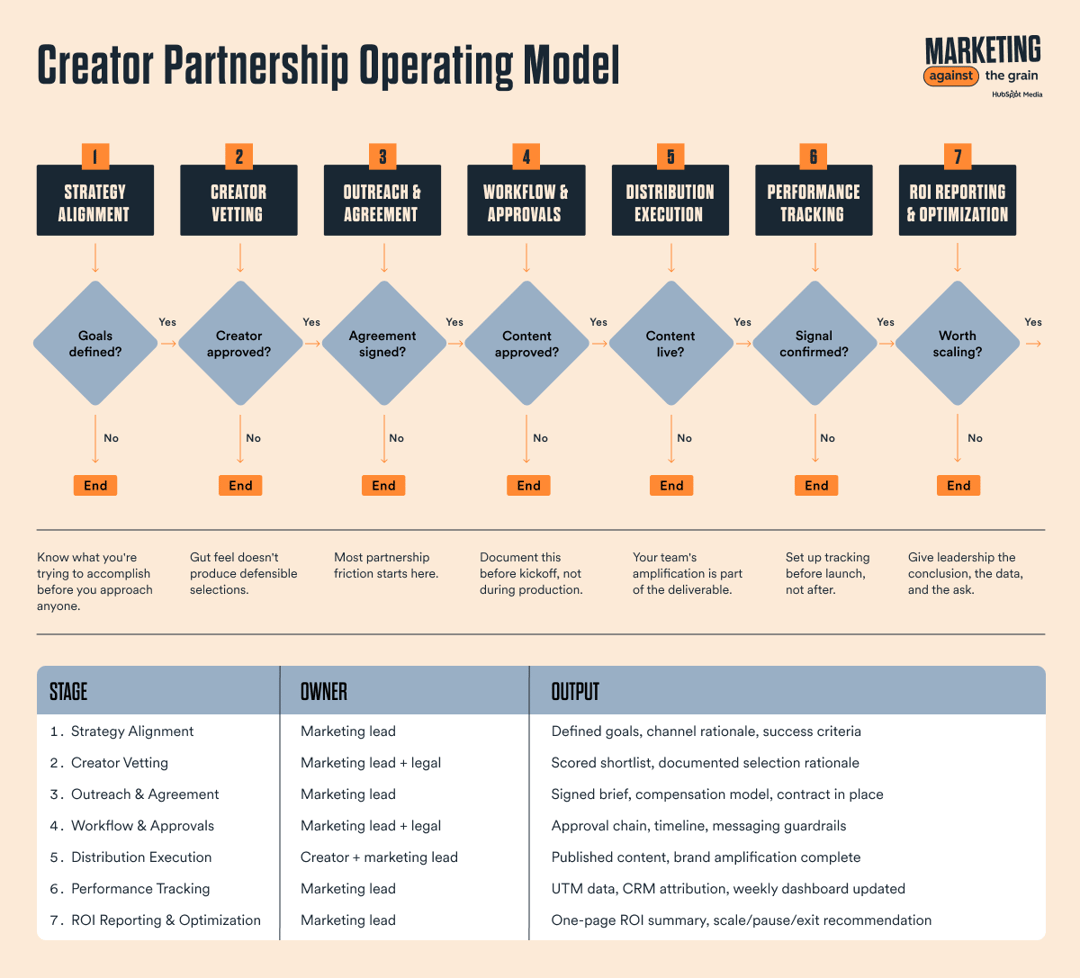
Section 2: The Creator Partnership Operating Model

Good instincts get you one decent partnership. They don't get you a repeatable channel.

What does is a process different people on your team can pick up, run, and hand off without losing context between stages. The operating model below maps the full partnership lifecycle. Every section in this toolkit corresponds to one stage. The goal is that every partnership you run, regardless of creator tier or content type, moves through the same structured process.

Light

Section 3: Creator Vetting Framework

If your creator selection process lives in one person's head, it breaks the moment that person gets busy, changes roles, or makes one bad call that a VP remembers for two quarters.

The framework below gives your team a consistent method for evaluating creators before outreach happens. It won't eliminate bad selections. It will make your criteria explicit, your tradeoffs visible, and your decisions defensible when someone asks why you picked who you picked.

Section 4: Outreach & Partnership Structuring

Most partnership friction starts before the first piece of content gets made. Vague scope, compensation conversations that happen after expectations are already set, deliverable definitions that mean slightly different things to each party. By the time content is in production, both sides are working from different versions of the agreement and neither one knows it yet.

Front-load the structure. Get to alignment on scope, timeline, format, and compensation before the relationship is formalized. It takes longer upfront and saves significantly more time later.

Initial Outreach

Cold outreach works when it's short, specific, and signals that you've actually engaged with the creator's work. Not skimmed their profile. Engaged. Reference something specific they published, not their follower count or general area of expertise.

Don't explain your company at length. Don't open with flattery. Lead with a concrete observation and a low-friction ask. Give them room to respond with questions or propose something different.

Warm outreach, where you have a mutual connection or the creator already knows your brand, can move faster. Re-engagement with past partners should acknowledge what worked previously and be explicit about what's changed or what you're proposing to do differently.


Creator Outreach Prompt Pack.

How to use this: Fill in every variable before running. Specific inputs produce usable outputs. Vague inputs produce templates.

Partnership Brief Alignment

Before any work begins, both sides need a written brief. Content scope and format. Timeline. Distribution responsibilities on both sides. Approval process and turnaround expectations. What happens if a deliverable doesn't meet spec.

This isn't a contract. It's a working document that prevents the mid-project conversations nobody wants to have. Most teams skip it because it feels like overhead. Most teams also spend two weeks in email threads arguing about what was originally agreed. The brief takes 45 minutes. The argument takes longer.


Compensation Models

There's no universal right answer here. The tradeoffs shift depending on creator tier, content format, your budget situation, and how much editorial control matters to you.

  • Paid arrangements give you the clearest deliverable expectations. They're appropriate for higher-effort content and established relationships where scope is well-defined. The risk: paid content can read as paid content, especially if the creator doesn't have room to speak in their own voice.
  • Affiliate models work when audience trust is high and the conversion path is short. For B2B purchases with 60- to 90-day sales cycles and attribution that's already messy, affiliate structures create more tracking complexity than most teams are prepared to manage.
  • Gifting and product access suit lower-commitment relationships where reach and credibility matter more than guaranteed output. Don't expect editorial control you haven't paid for.
  • Hybrid arrangements, a base fee plus performance incentive, can align interests when a creator is open to sharing in the outcome. The tradeoff is more negotiation time and a more complex contract. Worth it for high-value, long-term relationships. Probably not worth it for a one-off activation.

Section 5: Workflow & Content Governance

This is the section most teams skip. Then three weeks into a partnership, nobody's sure who's reviewing the draft, the creator has been sitting on feedback for four days, and the publish window is gone. By the time the content goes live, both sides are quietly frustrated. The relationship has taken damage before it's produced a single measurable result.

The approval workflow, messaging guardrails, and timeline structure get documented before kickoff. Not negotiated mid-project when everyone is already behind.

Content Approval Workflow

Decide before the partnership begins who reviews, in what order, with what turnaround commitment. Most B2B teams need at least a marketing lead review and a legal or compliance pass. Some require executive sign-off, which adds days. If your organization has that step, account for it in the timeline before promising anything to the creator.

The creator should know what the review process looks like before submitting their first draft. Discovering mid-partnership that there are three more approval layers than expected is a reliable way to strain the relationship and miss deadlines.


Section 6: Performance Tracking & ROI

This is where most creator programs lose leadership support. Not because the content underperformed. Because nobody set up tracking before launch and now there's no clean data to defend the spend.

"We got good engagement" is not a business result. "We generated 340 qualified leads from creator-attributed content at a $47 CPL, against our paid social average of $112" is. The performance may have been identical. The preparation wasn't.

Start with the business objective from Section 2 and work backward to the metrics that indicate progress toward it. Pipeline goal means UTM-tagged links, form completions, and CRM attribution, not reach and impressions. Credibility goal in a new market segment means qualitative signals alongside quantitative ones.

The metrics that look good in screenshots, views, likes, follower growth, are rarely the ones a CMO asks about in a budget review. Build reporting around the questions that will actually get asked, before anyone asks them.

Section 7: Scaling & Portfolio Management

One successful partnership is not a program.

The gap between a well-executed single activation and a repeatable creator distribution channel is mostly operational. Most teams underestimate how much of the infrastructure in Sections 3 through 6 needs to be formalized, not just used once, before scaling is viable. Doing more partnerships without that foundation doesn't produce a program. It produces more chaos at higher volume.