<link rel="stylesheet" href="https://53.fs1.hubspotusercontent-na1.net/hubfs/53/hub_generated/template_assets/1/207928094053/1776130434339/template_footer-core-non-critical.min.css">

Data Report

The AI Adoption in Email Marketing Report

We surveyed 300 email marketers to understand exactly how AI is reshaping their workflows — and where it's falling short. This research reveals the real challenges, wins, and gaps marketers face when implementing AI in email campaigns.

Unleash your brand's full potential with HubSpot's AI-powered Marketing suite, filled with tools that seamlessly connect to your CRM.

We know marketers are using AI – the question is, how much and how effective is it? To find that out, we surveyed over 300 email marketers.

They shared their hands-on experience with AI: which tools they're using, what results they're seeing, where they're hitting walls, and what they're still waiting for the technology to solve.

The TLDR here is that email marketers have moved past the curiosity phase and are now deep into the messy middle of adoption. This report breaks down exactly what that looks like.

Chapter One

The State of AI Adoption in Email Marketing

4-Feb-24-2026-09-30-12-4772-AM

If you’ve started using AI for email marketing within the last year, then you’re like most email marketers we surveyed.

Forty-four percent (44%) say their org has been using it for six to 12 months while roughly a quarter (28%) started in the last six months.

Earlier adopters represent the minority here, with only 28% reporting that they’ve used it for over a year.

As for how often they’re using it, here’s the breakdown:

30% use AI extensively
46% use it moderately
24% use it minimally

How does that usage translate to workflows? Four out of 10 email marketers we surveyed say 21 to 40% of their email marketing workflow involves AI tools.

3-Feb-24-2026-06-13-29-3724-AM

Another 30% of respondents say AI tools are involved in 41 to 60% of their workflow.

The outliers are those who don’t use it much (17%) and those who use it for over 60% of their work (13%).

This tells us that most marketers are in fact experimenting with AI but still working on finding that sweet spot.


Speaking of tools, 65% rely on general-purpose platforms like ChatGPT or Claude, while only 29% use their email platform's native AI features.

Custom-built solutions only account for 5%, likely because of the cost and the implementation required.

Takeaway: Audit where your biggest time drains are, then investigate whether your ESP's native AI features, even if imperfect, could reduce the copy-paste friction in your current workflow.

What Email Marketers are Using AI For

Email content generation is the most popular use case, by a large margin, while capabilities with the most strategic upside – like audience segmentation and predictive analytics – are the least adopted.

In other words, email marketers are using AI where it's easiest to deploy, not where it could have the most impact.

For instance, personalization is one of the most talked-about promises of AI in marketing. Yet, according to our data, only about a third of email marketers are leveraging it. 

Chapter Two

Why Marketers Are Still Doing Heavy Editing

There’s a huge quality gap happening between AI and email marketers.

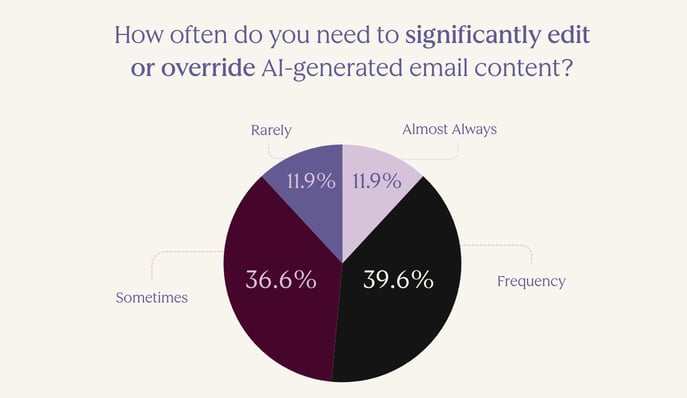
Most marketers are using AI to save time on content, but most are also spending significant time editing what AI produces. For nearly half the field, heavy editing isn't the exception, it's the default.

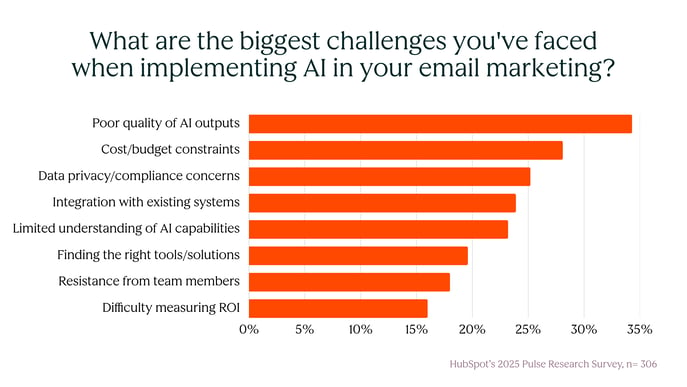
This suggests that email marketers spend more time editing AI copy than writing it from scratch. That’s why 34% of respondents cite poor-quality AI output as of their top challenges. The first was lacking in AI expertise, which can make it hard to leverage the tool.

So, it not only comes down to the limitations of the technology itself but also those of the user’s.

When asked more about the areas in which AI lacks the most, here’s what they revealed:

  • Understanding complex campaign objectives — 39%
  • Creating truly original creative concepts — 37%
  • Understanding brand voice/tone — 35%
  • Strategic planning — 35%

These aren't fringe complaints, they cluster around the same core problem: AI is good at producing content, but not at producing the right content without significant guidance. The challenge compounds for organizations with layered brand identities or niche audiences.

Notably, poor quality of AI outputs (34%) and lack of AI expertise (35%) were nearly tied as top implementation challenges — suggesting the problem is both the tool and the user's ability to get the most out of it.

Prompt to steal: "Write a [email type] for [audience]. Our brand voice is [adjectives]. We never sound [what to avoid]. Here's an example of our tone: [paste example]. Match this style throughout."

How 300+ Email Marketers are Leveraging AI Report Graphs

Chapter Three

The Real ROI Behind AI in Email

We won't bury the lede here: Email marketers are seeing positive ROI on the use of AI in email marketing. 

In fact, four out of ten marketers report seeing an 11 to 25% increase in ROI since implementing AI tools. 

Which email marketing KPIs have seen the most improvement from AI implementation?

Open rates

24%
Click-through rates

33%
Conversion rates

37%
List growth/subscriber retention

27%
Revenue attribution

28%
Time/resource efficiency

29%
Deliverability

22%
Customer engagement/satisfaction

14%

Time savings are also real.

54% save 1–5 hours per week, and 31% save 6–10 hours.

For a lean team, that's meaningful bandwidth — even if it isn't yet transformational.

Even here, we still have marketers at each end of the spectrum. Three percent (3%) report saving more 20+ hours while five percent report zero time savings. 

All that said, there are still 35% of email marketers who report struggles in measuring ROI. 

This means that while marketers feel like AI is working, a good amount can't prove it.

Chapter Four

What Email Marketers Want from AI

The clearest signal in this entire survey comes from one open-ended question: "What task in your email marketing workflow would you most like AI to solve that it currently cannot?"

The responses paint a detailed picture of where the technology needs to go — and what's still missing.

Here are email marketers' top 5 unmet needs, by volume of responses:


Collaboration_Linear_llustrations_Characters-3

Brand Voice Match

Marketers don't just want less robotic copy — they want AI that learns and holds their specific voice over time without needing to be re-briefed on every prompt.

The frustration isn't that AI can't write. It's that AI can't write like them, consistently, without intervention.

Productive Time_Linear_llustrations_Environmental_VectorBased-01-1

Audience Segmentation

Email marketers want AI to do everything from tailoring messaging to specific clients to determining which audience segment is most likely to open the email. 
HS_Pictograms_Easy To Buy_800px-1

End-to-End Automation

From writing and scheduling campaigns with minimal input to automatically drafting follow-up emails the moment a response comes in.

Respondents want AI to handle the operational lift so they can focus on strategy.

attract-4

Inbox Management

Sorting, triaging, prioritizing, and drafting responses to inbound customer emails at volume.

This was an underreported pain point — and one that very few AI tools are currently solving well for email marketers specifically.

Creator and Influencer Trends Report-1

Strategy and Analytics

Email marketers want AI that can connect campaign activity to business outcomes and help make higher-order decisions, not just execute on them.

Here's the through-line across all five: marketers want AI to reduce the operational burden so their judgment can go further. 

Conclusion

What Comes Next

If there's one overarching takeaway from this survey, it's that AI in email marketing is working — just not as seamlessly as most marketers hoped it would by now.

The ROI is real. The time savings are real. The KPI improvements are real. But so is the editing overhead and the measurement gap.

That said, 68% percent of respondents plan to increase their AI investment in the next year. What they probably know is that while AI may not be quite there yet, it's moving too fast to stay at this level for long.

It's only going to get better quicker and those have already begun experimenting will have the upper hand.