

+ Downloadable Resource

Social Media SEO Workbook

Your audience isn't just searching on Google anymore. Annie-Mai Hodge — founder of Girl Power Marketing — breaks down exactly how to get found on TikTok, Instagram, LinkedIn, and YouTube search results.

Supercharge Your Growth with HubSpot and Meta ads

Think about the last time you wanted to find a new restaurant in your area. Or a Pilates class that wouldn’t make you want to cry. Or a hairdresser who actually listens when you say “just a trim.” I’d be willing to bet you didn’t just Google it. You probably opened Instagram, or TikTok, or YouTube — searched for it there, watched a few videos, scrolled through some tagged posts, maybe checked the comments to see if anyone had a nightmare experience. And then maybe you Googled it too. And then went back to TikTok. And then asked a friend.

That’s the search journey now. It’s messy, it’s multi-platform, and it’s completely normal. We all do it. Your audience does it. And yet most marketing strategies are still treating Google like the only search engine that matters. Spoiler: it’s not. Not even close.

In this playbook, I’m going to walk you through the exact framework I use to make social content discoverable — on the platforms themselves AND on Google. We’ll cover keyword research, search intent, content ideas, profile optimisation, and how to plan a search-led post that people actually find. No gatekeeping, just everything I've learnt over the last four years, all in one place. And without the corporate SEO jargon.

Why Are People Using Social Platforms as Search Engines?

This isn’t just something I’ve been thinking. It all started back in 2022, when a Google Exec said that an internal report revealed that 40% of young people were already using TikTok or Instagram instead of Google when it came to searching for things, like where to grab lunch. But this shouldn’t be surprising. Traditional websites are full of display advertisements that make the page slow to load, and are typically full of word-vomit vs. social media platforms that provide easy-to-digest content with a healthy hit of dopamine.

  • TikTok videos have been appearing in Google SERPs for years. Google now has a dedicated “Short Videos” tab pulling in TikToks, Reels, and YouTube Shorts.
  • Individual Instagram posts and Reels started appearing in Google search results in July 2025. Not just your profile, your actual posts. Meaning your Instagram content can now compete with traditional websites.
  • Both Pinterest and Instagram have secured page one rankings for keywords with transactional intent — queries from people who are ready to buy.
  • LinkedIn is increasingly prioritized by Google for thought leadership and professional queries. It’s also becoming a primary, authoritative data source for AI search engines like ChatGPT, Perplexity, and Google AI Overviews.
  • YouTube has always been the second-largest search engine in the world, and it’s showing no signs of slowing down.
someone on social media

So what actually IS social media SEO?

It’s the practice of optimizing your social media content and profiles so they can be discovered through search — both within social platforms AND on traditional search engines like Google. It’s about understanding what people are searching for, matching the intent behind those searches, and creating content that surfaces where your audience is looking.

Social media SEO doesn’t mean you should be treating your Instagram captions like a blog post, or stuffing them with so many keywords that people end up rolling their eyes and scrolling past. Keywords matter, and will help your content show up in external SERPs but engagement signals like saves, shares and watch time help the algorithms understand how helpful your content is, meaning it’ll then potentially be served in other spaces like internal search, explore and suggested content.

Step One

Keyword Research: How to Find What People Are Actually Searching For

Before you can create content that gets discovered at different touchpoints, you need to know what your audience is actually searching for, but the problem is that there aren’t many tools specifically built for social media keyword research. There’s not quite a tool equivalent to Ahrefs or Semrush yet, but I don’t think we’ll have to wait too long, if I’m honest. But we can borrow from these traditional SEO tools, and combine them with what the platforms provide us, to build a pretty solid keyword list.

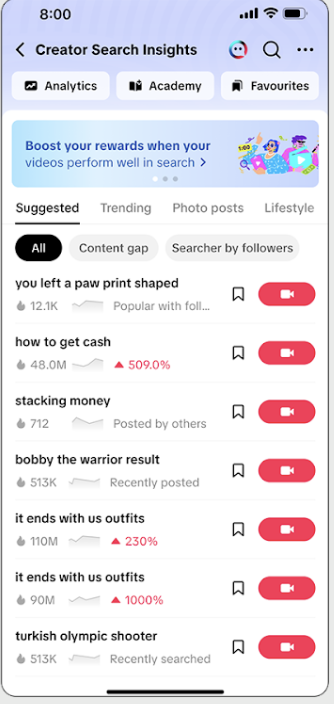
TikTok Creator Search Insights is one of my favorite resources that I think is still very underutilized, and it shows you what people are searching for, what’s trending and where there are content gaps and opportunities. And if you didn’t know, you can see in your analytics what percentage of people found your content via search, so you can see if your TikTok SEO efforts are actually paying off.

And then you’ve got tools like Google Trends, which compares search interest of terms and topics by time, location and popularity, which can help you create more reactive content because it shows you what people are searching for in real time.

If you want to go a little further, then you can use something like AlsoAsked, which aggregates, organizes and displays live “People Also Ask” data that appear within Google’s search results.

It’s one of the best tools that allows you to see what search engines, and users, are expecting you to answer in your content about a certain topic.

And, the data is incredibly easy to interact with and export, whether that’s into a gorgeous ready-made graph, or into a CSV format. If you want to add another tool into the mix, then it’s worth checking out Keywordtool.io, which is another free online research tool that uses Google Autocomplete data to help generate platform-specific and long-tail keywords on any topic.

"We can borrow from these traditional SEO tools, and combine them with what the platforms provide us, to build a pretty solid keyword list."

annie-mai hodge
Annie-Mai Hodge

Founder, Girl Power Marketing

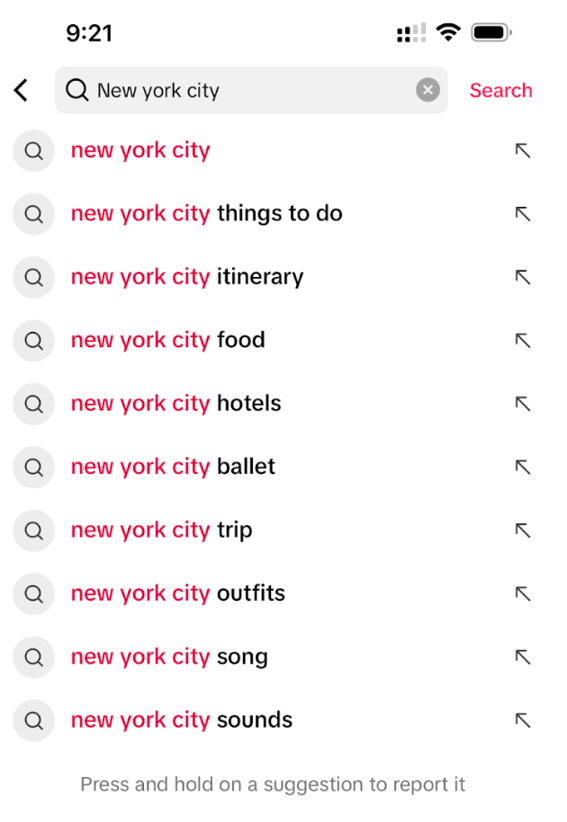
using the search bars on each platform

And one of my favorite, simple and native options: utilizing the search bars on each platform. All you need to do is start typing your question, or keyword, into TikTok, Instagram or YouTube’s search bar and look at what auto-suggest options appear.

Now, here’s another important note about keywords. Your primary keyword is your main topic or phrase that you want your content to rank (appear) for, such as “how to grow on LinkedIn” or “best restaurants in Norwich” – both of which are what we call long-tail keywords, which allow you to target niche demographics, and tend to be less competitive. Whereas short-tail keywords are more broad, and generally have a higher volume, they’re more competitive, and the intent is much more vague.

(For example: trying to rank for “best restaurants in Norwich” will be easier, regardless of what platform you’re using, than trying to rank for “best restaurants”.)

someone researching keywords for social media

Then we’ve got your secondary keywords, which are related terms that add context, like “LinkedIn growth tips 2026” or "Norwich restaurant recommendation” – using both gives the platform more signals and context as to what your content is about (a bit like how hashtags work now on Instagram and TikTok, they’re not necessary, but they provide context) without stuffing one phrase into your content a million times and calling it a day.

While this isn’t directly important when it comes to ranking social media, it’s good practice and means that you’re covering every basis to start ranking competitively.

As I said in the HubSpot article I contributed to, it’s best to use natural language that addresses user intent, and include relevant keywords without compromising readability. If it sounds weird when you read it out loud, it IS weird.

Downloadable Resource

Your Social Media SEO Workbook

Keywords tell you what people are searching for. Search intent tells you why. And the “why” is where the magic happens.

Understanding intent is arguably more important than the keyword itself, because it shapes everything: the angle of your content, the format it takes, and whether it actually satisfies what someone was looking for. Get the intent wrong? And even perfectly optimized content will flop because you’re confidently answering a question nobody asked.

Now, there are four types of search intent to know.

They want to learn something. “How to start a podcast” / “What is social media SEO.”
They want to find a specific brand or page. “Girl Power Marketing LinkedIn” / “The Social Tea newsletter.”
They’re researching before a purchase. “Best ring lights for content creators” / “Notion vs Asana.”

They want to take action. “Buy Elgato key light” / “Sign up HubSpot free.”

To figure out the intent behind your keywords, take each one and search it on TikTok or Instagram.

four types of search intent

What are the top results? Are they tutorials? Product reviews? Carousels? Someone sitting in their car giving a monologue? (It’s always someone in their car.) That dominant format is your biggest clue about intent. Then do the same on Google — look at whether the results page is showing videos, shopping results, or long-form articles. Cross-referencing both platforms gives you a fuller picture of what people expect.

Step Three

Content Planning: Turning Keywords Into Content That Actually Stops the Scroll

You’ve done the research, you know what people are searching for, and you understand the intent behind those searches. Now this is where the real fun starts, as it’s time to turn all of that into content ideas. Each idea you come up with should tick three boxes:

You don’t need to try and reinvent the wheel here, just remember what you’ve learnt so far. If every top result for your target keyword is a carousel, don’t try to fight it with a static image and a prayer. Work with what the platform, the audience and your own data tells you. Because yes, you need to look at your insights to get an idea of what resonates with your audience first, because if they like it, then it’ll be pushed to non-followers. And your dreams of ranking in social media search results comes one step closer.

content gaps

One of my favorite things to do at this stage is look at what’s not being said, a content gap, and this? It’s your golden ticket. Because your content will be relevant, it’ll feel familiar, but it’ll have an angle that’ll make people think “wow, this is exactly what I’ve been thinking” and that’s the feeling we want to create.

I started really building, and carving out my personal brand this way. In 2020, I saw a shift in how user behavior was changing on TikTok and how people were using it for search purposes.

And in 2022, I realized no one was really talking about it, and if they were, they weren’t telling you how to action it – so there it was, my content gap. I started writing about it, and the impact meant I was invited on podcasts, to go to events, and people still know me for this content now in 2026.

"One of my favorite things to do at this stage is look at what’s not being said, a content gap, and this? It’s your golden ticket."

annie-mai hodge-2
Annie-Mai Hodge

Founder, Girl Power Marketing

Step Four

Profile Optimization: Make the Algorithm Like You Back

Your profile is doing more work than you think, it’s a double-act. Firstly, it acts as a landing page for your followers and non-followers, and secondly, it sends signals to the platform about who you are, what your account is about, and what topics you’re associated with.

Remember: you don’t want to be everything to everyone. You need your profile to be clear, accessible and most importantly, discoverable.

Your profile on each social media platform will work slightly differently, but here’s some things to keep in mind when optimizing each one:

There have been rumors for many years that saying “link in bio” in your caption will impact the reach of your content negatively, but Instagram recently confirmed this year that this isn’t the case. 

Pro Tip

Keep it simple, searchable, and consistent across platforms. There’s nothing worse than trying to find a brand you found on TikTok, on Instagram (for further research, of course) and you can’t because it’s completely different. Ideally, no random underscores, or numbers that make it look like a password.

This is your opportunity to include a primary keyword. So for me, on my business Instagram, I use “Annie | Social Media Marketing” but on my personal TikTok, I might use “Annie | FTM” because they’re different accounts, with different purposes. Think about what someone would actually type into a search bar to find someone like you.

Make it immediately clear who you are, what you do, and who you help. This is your opportunity to weave in your secondary keyword naturally, giving your profile another opportunity to appear when someone is searching for an account like yours.

Remember, we want to give our audience and platforms as much context as possible. So for Instagram, you need to be utilising the “Highlights” feature, because although they won’t help your content rank, it will help engage profile visitors for longer, which shows Instagram that what you’re posting is genuinely useful, and help get your future content showing up in search, and suggested. On LinkedIn, you can use the “Featured” section to showcase content that supports what you’ve written in your heading, and in your “About” section – leaving no room for any misunderstanding regarding what you post content about.

If you’re trying to take that extra step, and get people to click off the platform, then you need to direct them somewhere useful, current and relevant. It’s your gateway to increased visibility, generating more traffic, and potentially conversions. Most importantly? Make sure yours isn’t pointing to a forgotten 2019 landing page, and that the link actually works. We’ve all done it.
Annie's own Instagram account page
Annie's pinned content
Annie's featured content
Annie's Instagram links

Creating Your First Search-Led Post

You’ve done the hard work, so take a moment to congratulate yourself for getting this far. The more you do it, the easier it’ll get and it becomes a really fun part of your content creation process – especially when you start seeing the work pay off.

So, now that we’ve done the keyword research, identified intent, brainstormed ideas, and tidied up your profile – it’s time to take one of those content ideas and actually bring it to life.

No more planning, no more theoreticals. We’re doing the damn thing and putting it out into the algorithmic universe.

Look at your content ideas and see if there’s a clear gap in what’s currently ranking. Can you offer a unique perspective or, dare I say it, a better execution? Is it something your audience would save, share, or come back to? It’s like picking your favourite child, you don’t have one but you love them all in different ways. At least, that’s what my mum told me.

ANYWAY, when I’m deciding what content to create for myself, or clients, I ask myself if I’d stop my scroll to actually read this content. If the answer is no? It’s back to the drawing board to rework it. Your content is competing with, quite literally, more content than ever before alongside AI slop, and people relating their wedding to some B2B marketing lessons.

Search your keyword on TikTok, Instagram, Google, Reddit, etc. What’s already ranking? What are the comments asking for that the content doesn’t cover? That gap is your opportunity. TikTok’s Creator Search Insights can even surface content gaps — queries people are searching but not enough content exists for – making your life a lot easier.

Map out your primary keyword, secondary keywords, search intent, format, hook, key message, relevant hashtags, caption with keywords woven in naturally, and a clear call to action. A note on hashtags: they’re not dead, but they don’t impact reach like they used to before in the Golden Age of Social Media. Think of them less as a growth hack and more as contextual signals that help platforms categorize your content. Use specific, relevant ones rather than generic tags like #marketing or #fyp.

Now, you’re ready to create your first post. The best planning in the world means nothing if it lives in this workbook forever, so create the content, apply everything you’ve learnt and hit the publish button. Once it’s live, monitor your analytics to see if it’s resonating with your audience, and non-followers, as well as if it’s actually appearing in search results. As a note, you can see if your content is appearing in search results on Instagram and TikTok in your analytics, but there’s no way to natively see on these apps if your content is ranking in external SERPs like Google. So the manual, and uh boring, way that I do it, is just type my keywords into Google.

It’s important to note that your social media content will be competing with traditional websites, most of which have been implementing an SEO strategy for years and years. So don’t be disheartened if you’re struggling to compete with these behemoth brands.

Not everything will be a hit, but everything is data and a lesson. So learn from it. If content “flops” , pop it into a content graveyard, and rework it at a later date, or when it’s more topical.

Pro Tip

👋 Bonus Tips

What’s Next

Congratulations, you’ve finished the workbook! Now you have a real framework that you can implement in your social media strategy moving forward: keyword research to find what your audience is actually searching for, search intent to understand why, content ideas mapped to real demand, an optimised profile that signals what you’re about, and a process for creating search-led posts with discoverability baked in.

This isn’t a one-and-done exercise. The real power of social media SEO comes from making it part of your regular content planning workflow. Run through this process every time you’re planning content for a new client or campaign. Revisit your keyword list monthly. Monitor content performance to spot which keywords and formats drive the most discovery. And keep an eye on emerging trends — platforms move fast, and what will perform well this week, might look different in six months and vice versa.

But ultimately: social media and SEO are no longer separate strategies, they’re fundamentally intertwined and it’s only going to grow in importance as social platforms (ahem: Instagram and LinkedIn) improve their search capabilities.

I hope this has proven that you don’t need to be an SEO expert to make your content discoverable, you just need to understand what people are looking for and show up where they’re searching.

We were born lost, but now, you are found (on social media and in search engines) – if you know that quote, without the brackets, we can be friends.

I hope you found this workbook helpful, it’s an ever-evolving space with no real and tangible data or resources to help you in your journey. But by implementing these tips, and making it a core part of your social media strategy, you’ll be able to increase discoverability and searchability in a way that you weren’t able to do before.

Note from Annie-Mai

Downloadable Resource

The Social Media SEO Workbook