



<link rel="stylesheet" href="https://53.fs1.hubspotusercontent-na1.net/hubfs/53/hub_generated/template_assets/1/202012046126/1767906842387/template_footer-core-non-critical.min.css">

Free Framework

The AI Leadership Decision Framework: When to Automate vs. When to Connect

From $20M deals to everyday decisions, learn the three-phase framework for balancing AI automation with authentic human connection to drive revenue, retention, and lasting relationships—from former Microsoft and Salesforce executive Julissa S. Germosén.

Explore HubSpot's AI-Powered CRM, designed to turn creative AI ideas into automated workflows across marketing, sales, and service.

As a leader right now, I have no doubt that decisions around AI are swirling in your head. Are you investing enough? Are you investing too much? Are you keeping up with your competitors? 

I’ve noticed a paradox lately: The companies winning the AI area know exactly when not to use it.

They realize that you don’t have to choose AI and human connection as all-or-nothing deals. But instead, it’s about knowing precisely when each one matters most. 

After two decades leading global teams and driving over $1B in business impact at Microsoft, Salesforce, and high-growth startups, I've learned this hard truth: the ROI doesn't come from the platform or the product. It comes from trust. 

And in the age of AI, that trust — what I call relational capital — is becoming your scarcest and most valuable resource. 

In this article, I’ll share a framework for building relational capital and help you think through making strategic decisions around automating or connecting.


Julissa S. Germosén is the founder of Trust Capital AI and a leading voice on building trust infrastructure for the AI era.

With 20+ years at Microsoft and Salesforce driving $1B+ in business impact, Julissa brings rare credibility: a tech executive who understands both the AI revolution and the human dynamics that determine whether transformation succeeds or fails.

She has spoken at TED, Google, Merck, IBM, and CME Group, testified before the U.S. Senate, and been featured on NPR and Forbes. Her 5X award-winning book Latina Madrina was selected for the US Library of Congress.

Her proprietary frameworks — Currency of Connection™ and A.C.T. Framework™ — give leaders actionable systems for building trust as a competitive advantage.

She is living proof that connection is not a soft skill — it's a growth strategy.

Meet the Expert: Julissa S. Germosén

Three Phases of Leadership in the AI Era

Automation_Illustrations_Color_LightBG

This framework didn't come from a whiteboard. It came from the day we lost $20 million.

Picture this: Microsoft conference room.

Fourteen executives. A digital transformation solution we'd been working on for months.

The tech stack? Best in class. The ROI for the customer? Bulletproof.

And the CIO looked across the table and said, "We don't trust you people to care about us."

You people.

Even saying it now, I get chills.

Because somewhere along the line, we stopped being humans working with humans. We became "you people" working with "those people."

And that disconnect cost us $20 million.

That loss taught me something I've seen proven over and over in twenty years leading in tech: every business decision is a trust decision. Every innovation is a relationship vote. Every strategic initiative flows through connection.

But here's what's happening in organizations right now—and most leaders don't even know it's occurring. I call it relational bankruptcy. It's happening at scale. And it's costing us speed, opportunities, and revenue.

AI is becoming commoditized. We all know it. But connection and trust? That's the moat.

That's why I built the Currency of Connection framework. Not as theory—as a survival strategy for leaders navigating a world where the tools are table stakes and the relationships are the real differentiator.

I’ve created this three-part framework below to help you navigate these phases. 

There are many hidden costs of relational bankruptcy:

Available

  • Customers who don't renew because the relationship feels transactional.
  • Top talent who leave because they feel like a cog in the machine.
  • Partnerships that dissolve because transparency and trust were never established.
  • Innovation that stalls because regional teams never built the trust to challenge assumptions.
  • Teams that don't collaborate across silos.

That loss taught me something I've seen proven over and over in twenty years leading in tech: every business decision is a trust decision. Every innovation is a relationship vote. Every strategic initiative flows through connection.

julissa
Julissa S. Germosén

Founder, Trust Capital AI | Keynote Speaker | Bestselling Author

Phase One

Diagnose Relational Bankruptcy

Relational bankruptcy is when organizations lose the human infrastructure (like trust, collaboration, and authentic connection) that drives performance. It’s a silent killer for even the best teams. 

While you’re focusing on accelerating your AI adoption, you may be unknowingly deepening the disconnection that's stalling innovation, weakening culture, and creating friction no tool can solve.

There are many hidden costs of relational bankruptcy:

HubSpot_Meeting_Illustration_Color_LightBG

How can you know if you’re sliding into this area? These are some of the warning signs you should be looking out for:

  • Your team uses Slack but rarely picks up the phone.
  • Meetings feel performative instead of productive.
  • "Collaboration" means email chains and shared docs.
  • Customer relationships are managed entirely through your CRM.
  • 1:1s feel like status updates rather than real conversations.
  • People say "we should connect," but never do.
  • Cross-functional projects move slowly because there's no established trust.

If you’ve selected yes on any of these, ask yourself this question: Where are we automating connection, and when should we be deepening it? 

This will help you see which areas you should focus on salvaging and rebuilding that human connection.

Phase Two

Build Relational Capital

To rebuild trust, you need to invest in relational capital. 

When I say relational capital, I’m referring to the accumulated trust, credibility, and goodwill you build through consistent, authentic human connection. It's what makes people advocate for you in rooms you're not in. It's what turns a client relationship into a partnership. It's what makes your team execute at a higher level.

Relational capital is the trust infrastructure AI needs to work. 

AI can analyze customer data, but it can't rebuild trust after a failed implementation. AI can draft the message, but it can't read the room when your team is burned out. AI can schedule the meeting, but it can't create psychological safety.

Where Relational Capital Matters Most

  • When there's ambiguity, change, or high stakes 
  • When you need honest feedback, not filtered responses 
  • When innovation requires risk-taking and vulnerability
  • When alignment across silos is critical to execution
  • When they're evaluating whether to renew or expand 
  • When an implementation goes wrong and trust is on the line
  • When they're choosing between you and a competitor with similar features
  • When you need them to be an advocate, not just a user
  • When you're negotiating complex deals 
  • When you need them to prioritize your requests 
  • When market conditions shift, and relationships determine survival 
  • When co-innovation requires deep mutual investment
Airport1_Security_Illustrations_Color_LightBG

The key question to ask yourself here: Where does human connection create disproportionate value that AI can't replicate? 

When I was at Microsoft, I worked on a deal that was going sideways. There was $20 million on the line, but the relationship was fraying, and the executives were reconsidering the decision. At the time, AI would have been able to tell us what was happening with the data … but it certainly could have told us what was happening in the room.

So, I decided to get on a plane so I could meet the team face-to-face. As we sat across the table, I listened and noticed what wasn’t being said. One conversation at a time, we were able to build back trust. I’m certain that wouldn’t have happened without that human interaction. 


Relational capital is what saved that deal.

Phase Three

Scale Relational Currency

Where Relational Currency Fits in the AI era

The more AI-driven our world becomes, the more people crave real connection. The companies that understand and systematize relationships turn authenticity into a measurable business advantage. 

Relational currency is what separates leaders who survive disruption from leaders who thrive. It’s both measurable and repeatable. Plus, it can serve as a growth driver for your company.

However, relational currency requires you to reframe your thinking. Teams need to shift from “we should connect more" to "connection is built into how we operate." 

Here’s what relational currency looks like in action:

Internally

Externally

Leaders who have 1:1s that people actually look forward to 

Customers who renew because of the relationship, not just the ROI

Teams that collaborate across silos without friction 

Partners who prioritize you when resources are constrained

Cultures where people stay because of the relationships, not just the compensation

Advocates who refer you without being asked 

Innovation that happens because trust enables honest challenge and debate

Deals that close faster because trust was already established 

Growth_Illustrations_Color_LightBG-1

After we lost that deal, we had a choice.
We could walk away. That's an option. Or we could stay engaged and remain human.
Our team decided to stay human.

Here's what we did: We made connections—not with our teams, not with our subject matter experts—but with industry leaders who could help them. We sent research and gave them insights they didn't have. We decided to show up as people versus vendors.

Many in the organization asked me, "Why are we doing this? They chose our competitor. We're wasting our time."

Fair questions. But we knew something most didn't.

We knew we needed to build the trust infrastructure because it wasn't there. And when do you build infrastructure? You build it before the traffic comes. You build it to meet the future need.

So we built that trust layer and foundation.
Then we got the call. Honestly, it was a surprise.

The conversation went like this: "We need to talk. The deployment is not going well. And you're the only vendor that we trust."

We won that deal back.

Not because our solution was better—it was an apt competitor. Not because we discounted. Because we built that infrastructure when we had nothing else to gain.

That's the difference between companies operating in relational bankruptcy and companies operating in relational currency. AI can surface insights all day long. But it can't build the trust layer. Only humans showing up for humans can do that.

That's the difference between companies operating in relational bankruptcy and companies operating in relational currency. AI can surface insights all day long. But it can't build the trust layer. Only humans showing up for humans can do that.

julissa-1
Julissa S. Germosén

Founder, Trust Capital AI | Keynote Speaker | Bestselling Author

That $20 million deal I won back? I can trace it directly to trust velocity. When their deployment failed, the CIO didn't call our competitor who'd been in there for six months. He called us—the team that had spent six months building relational capital with nothing to gain. Same technology. Same market. The only difference was the trust infrastructure we'd built. That's relational currency in action: when the moment matters, you're the call they make.

When to Automate with AI

WorkSpace_Illustrations_Color_LightBG
  • The outcome is transactional (scheduling, data analysis, routine updates) 
  • Speed and efficiency are the primary value drivers 
  • The relationship is already strong and doesn't need deepening 
  • The interaction is high-volume, low-complexity 
  • Consistency and accuracy matter more than nuance 
  • The emotional stakes are low 

Your customer success team gets 200 tickets a day asking how to export a dashboard or reset a password. Every minute someone spends on that is a minute they're not saving the enterprise account that's at risk of churning. AI can handle the volume, so your team can handle tasks with the highest value.

Here's what this looks like in practice:

Your executive assistant used to spend hours playing calendar Tetris across time zones. Now AI finds the slot, sends the invite, and everyone moves on. Nobody's relationship got deeper because a human scheduled that meeting.

Your weekly pipeline review doesn't need someone manually pulling numbers into a slide deck. AI generates the summary, flags the anomalies, and your team walks in ready to talk about what the data means, instead of what the data says.

Your Monday standup notes, your project tracker updates, and your "just keeping you in the loop" emails are prime routine opportunities. Let AI draft them, give them a quick scan, and move on.

When to Connect as a Human

Sales Deal_Illustrations_Color_LightBG
  • Trust is fragile or needs to be rebuilt 
  • The stakes are high (big deals, hard conversations, major changes)
  • Ambiguity requires judgment, not just data
  • Emotional intelligence and reading the room matter 
  • Long-term relationship depth will create disproportionate value 
  • Innovation, creativity, or vulnerability are required 
  • Authenticity and transparency will differentiate you in a commoditized market

Let’s imagine your longest-standing customer just scheduled a "check-in call" out of nowhere without any context. To prepare, AI could surface that their usage dipped last month, and they haven't opened your last three feature announcements.

However, the real challenge becomes apparent during the meeting. During the call, the customer reveals that their new VP of Marketing wants to consolidate vendors, and your champion is trying to figure out how to fight for you. That's a relationship you’ll want to save in person.

These are the moments that require the human touch:

You're not sending a Loom video to tell your head of marketing that the campaign missed. You're sitting down, reading their reaction, making space for them to respond. The message itself matters less than how it lands.

Disagreement about pricing strategy? AI can model every scenario you want. But the actual alignment (where you both feel heard and commit to a direction) happens face to face, probably with some tension before there's resolution.

When you're restructuring the SDR team because the GTM motion is shifting, the org chart is the easy part. The conversation with the manager who built that team from scratch is the hard part, and she needs to see your face when you explain it.

Your biggest account just posted something lukewarm about you on LinkedIn. This shouldn’t be a support ticket. This should be you picking up the phone to say, "I saw it, I want to understand what we're missing."

When to Use Both

This is where leaders can get the most leverage. AI does the prep work, so you show up more strategically.

AI pulls their account health data, usage trends, support history, and recent product engagement. You walk in knowing what questions to ask instead of spending the first ten minutes figuring out what's actually going on.

AI drafts the structure. You rewrite the two paragraphs that actually matter and add the context only you have. The scaffolding is handled; the insight is yours.

AI schedules it and handles the logistics. You show up present, not distracted, trying to find a conference room or figure out who's dialing in from where. The coordination is solved, so you can actually listen.

AI surfaces the trend in your NPS comments or community threads. You're the one who decides what it means and how to respond. The pattern recognition is automated; the judgment call is human.

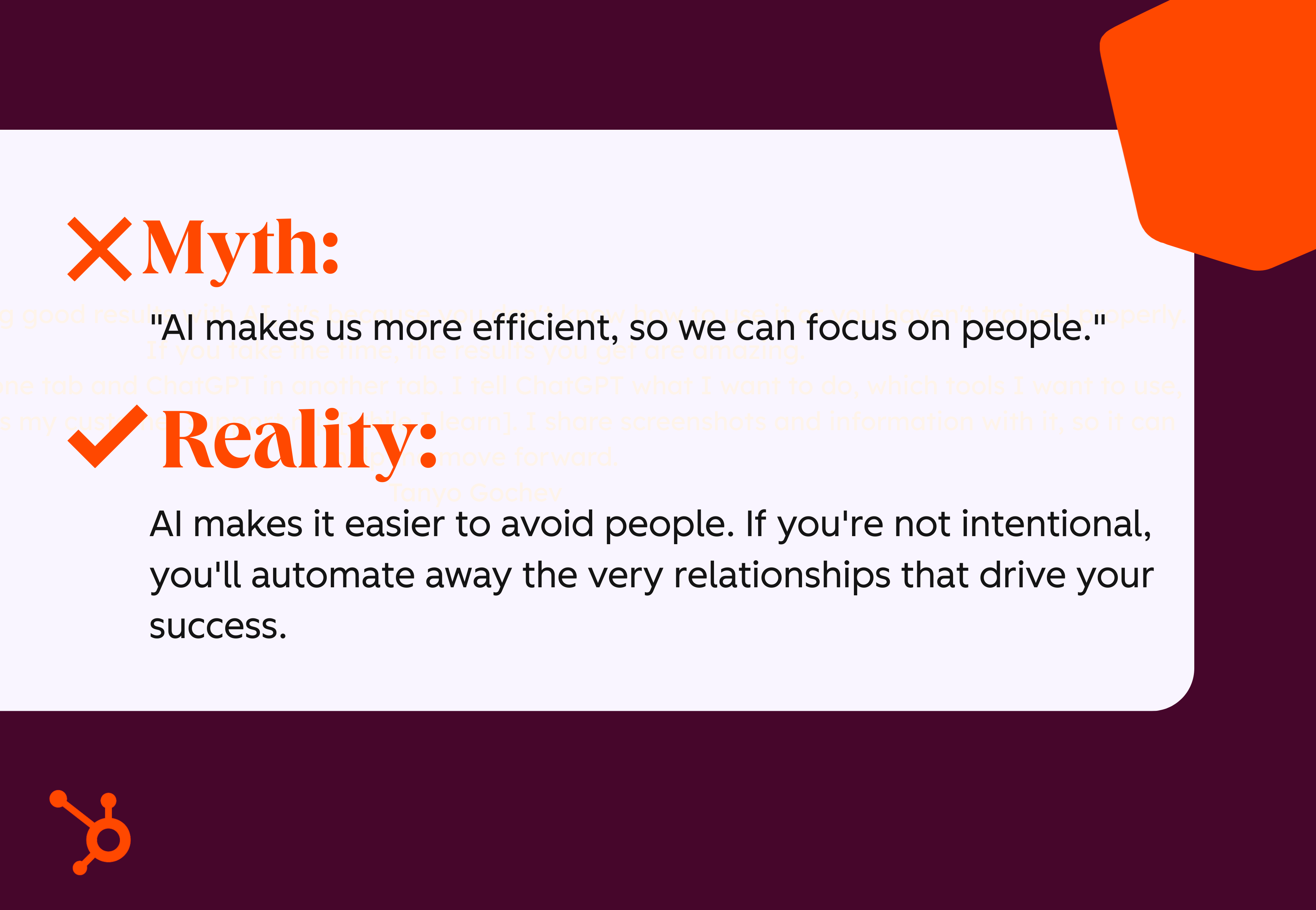
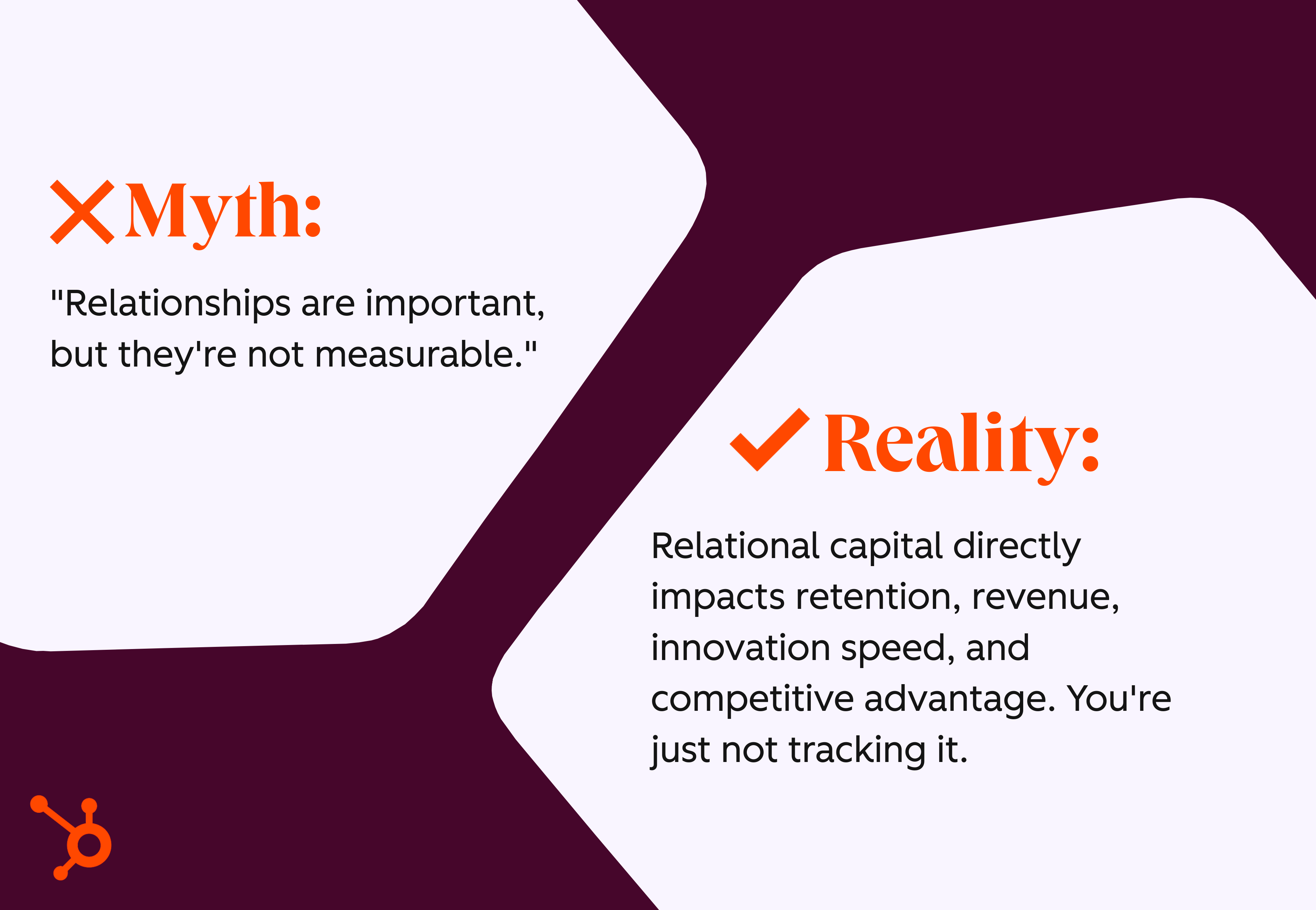
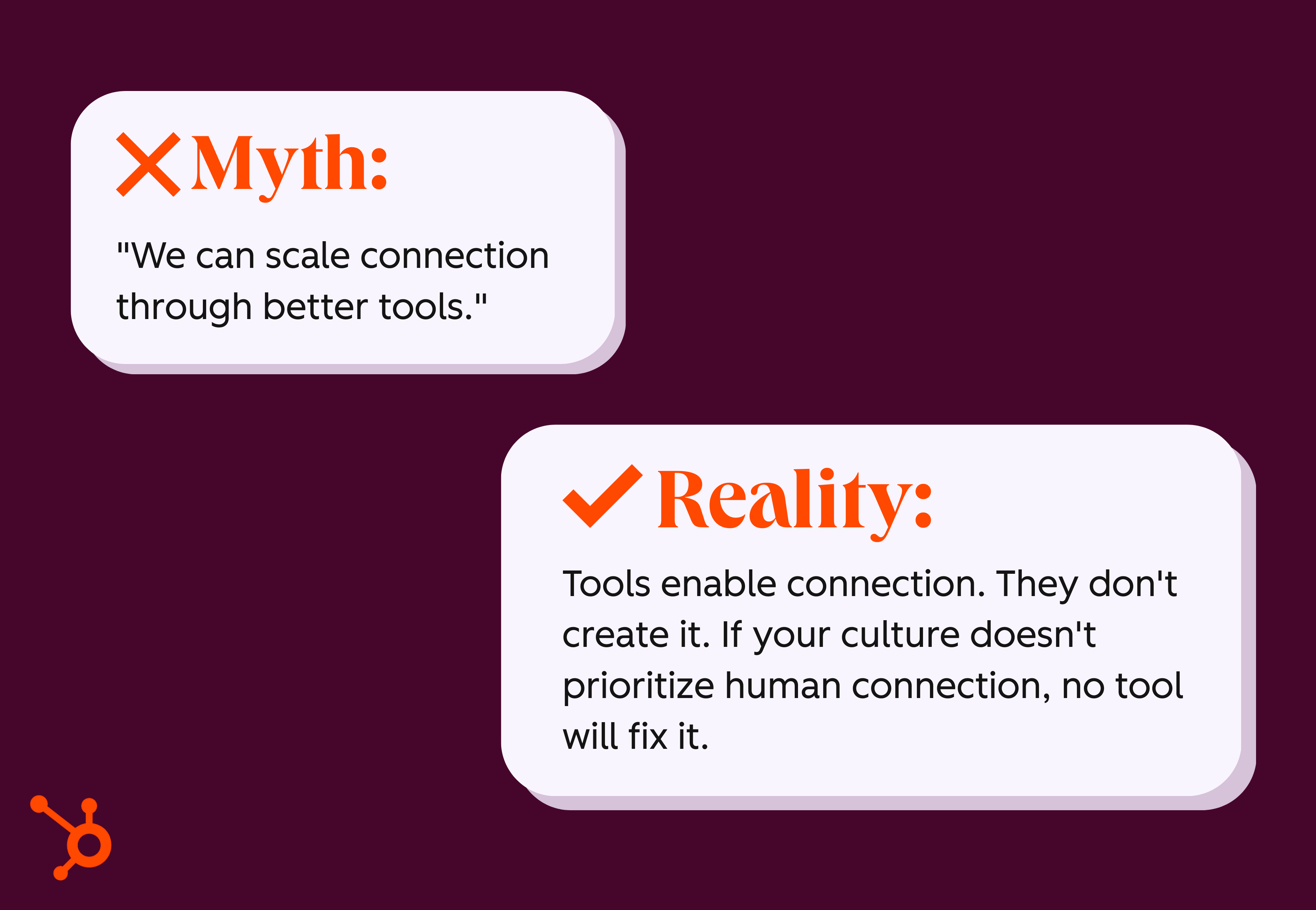
What Leaders Get Wrong About AI + Connection

Your Action Plan

30-Day Relational Strategy Plan

Knowing when to automate versus connect is one thing, but actually shifting how you and your team operate is another. And I've found that the weak spots are often the hardest to see. You don't always notice when a customer relationship has gone stale or when your 1:1s have turned into status updates until something goes awry.

So, I've put together this 30-day relational strategy plan to help you run a structured audit on where your relational gaps actually are. It'll help you prioritize which ones are worth closing, give you a specific plan for rebuilding, and show you how to integrate connection into your existing rhythms, so it's not something you have to remember to do. 

Once you're clearer on where human connection matters most, you'll also have a much sharper sense of what you can confidently hand off to AI.

The AI vs. Human Decision Flowchart

Every interaction that crosses your desk represents a choice: Automate it or connect human-to-human. I spend a good chunk of my advisory work helping leaders figure out what that looks like for their specific teams and companies, because the answer really does vary.

The flowchart captures how I make the choice. 

If you're looking at meeting coordination, pipeline reporting, or drafting that first version of a nurture sequence, and the relationship is already solid, let AI handle it. If you're navigating a tense conversation with your co-founder about pricing, or a key customer just went quiet, it’s time to pick up the phone. 

And sometimes, it's both: AI pulls the account health data and usage trends, so you walk into that customer call already knowing what questions to ask. 

Here's the full framework you can work through for yourself:

the ai versus human decision flowchart

The Leadership Advantage AI Can't Replicate

AI is going to keep getting smarter, faster, and cheaper. And, your competitors have access to the same tools you do. There's no moat in the technology itself.

Real relationships help teams stand out. The trust you've earned and the conversations you've had become valuable currency. Connection lives in moments where you showed up when it would've been easier to send an email.

The leaders who thrive in the age of AI won't be the ones who automate everything. They'll be the ones who know exactly when to automate and when to connect. When AI can do almost anything, connection will set you and your company apart.

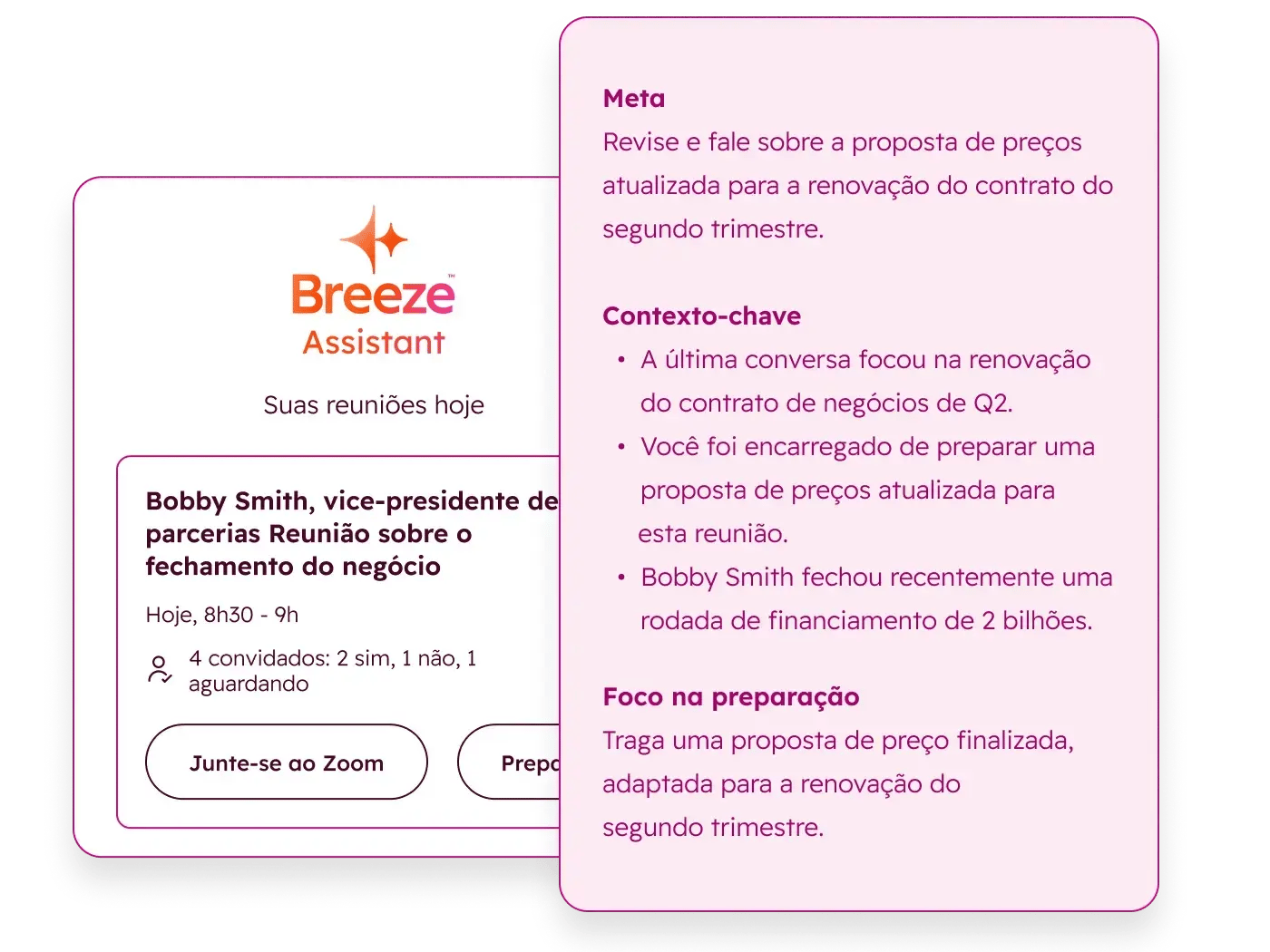
Breeze – Meeting Insights_pt

HubSpot’s Breeze: AI That Works Where You Do

AI tools built into HubSpot to help you work faster, save time, and focus on what matters most. From writing to reporting, Breeze helps you move quicker and get more done.