Content Marketing Planning Guide

Insights from HubSpot's Marketing Moguls

Content Marketing Software: All-in-one, AI-powered software that helps marketers create and manage content.

Foreword from Jonathan Hunt,
VP of Media, HubSpot

Content still reigns supreme in marketing, but the playbook is being ripped up and rewritten...

A full-blown AI revolution, search engines innovating faster than anyone can keep up, a relentless drive for hyper-personalization, and an unprecedented audience exodus from once-reliable media models in favor of subject matter experts and niche brands. Not only are the rules changing—it can feel like a fundamentally different game.

Want to thrive, not just survive? It's all about agility, adaptability, strategic content planning, and not just being good but being better at creating inimitable value for audiences.

Inside this kit, we provide several templates to empower you to plan around the complexities of modern content marketing, giving you the foundation to build a winning strategy.

I hope this guide is as actionable for you as it is inspiring.

Jonathan Hunt Headshot

The future of media is being built as we speak—are you in?

Jonathan Hunt

Vice President of Media

HubSpot

The Importance of Content Marketing in 2025

Even now, content is king. You search for information. You read blog posts. You download guides, whitepapers, and templates. You subscribe to newsletters and engage with content delivered directly to your inbox. You downloaded this guide, a product of content marketing, to learn more about creating killer content in 2025. Content isn’t just king—it’s one of the most important aspects of delighting customers, driving revenue, and creating a memorable brand.

The positive impact of content marketing couldn’t be clearer:

74%

of companies report content marketing as effective in increasing lead generation.

67%

more leads per month are generated by companies with blogs compared to those without.

But not all content is created equal. It’s so much more than inputting a prompt into ChatGPT and getting your next big blog post. It’s taking intentional, calculated steps to create content that your customers will crave.

That’s where content marketing planning comes into play. We’ll walk you through each step of creating effective, comprehensive content marketing campaigns, from assessing your current efforts to setting goals to planning your next campaigns and more.

How to Use the Content Marketing Planning Templates

You’ll find each template within the Content Marketing Planning Templates sheet, which includes templates for:

  • SWOT Analysis
  • Customer Segmentation
  • Content Marketing Planning
  • Search engine optimization
  • Content marketing campaign planning
  • content marketing performance tracking


Download Content Marketing Planning Templates

To begin, make a copy of the content marketing planning templates using the button below.

Assessing Your Current Content Marketing Efforts

If you’re like 97% of other marketers, you’ve probably already engaged in some kind of content marketing. You might’ve published a few articles to your blog, or even created video content for social media. Regardless of what kind of content marketing you’ve already done, take time to assess your current efforts. That way, you can:

  • Identify gaps in your content marketing strategies
  • Optimize existing content to boost engagement and reach
  • Align your content with current audience needs and trends

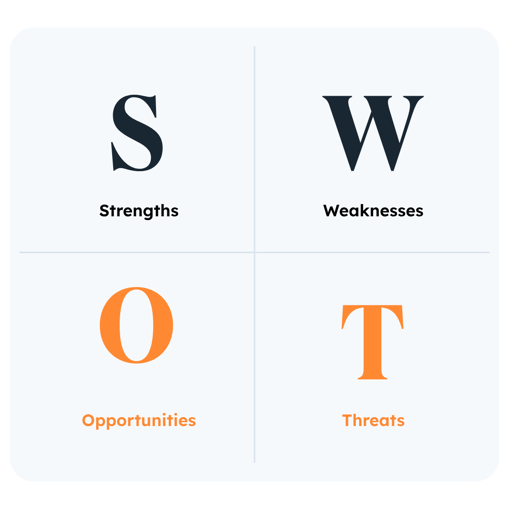
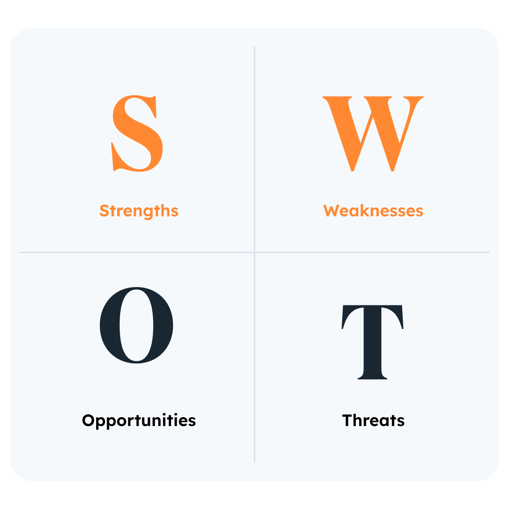
To get started, try conducting a Strengths, Weaknesses, Opportunities, and Threats (SWOT) analysis. A SWOT analysis helps you assess the good and bad of your current efforts and can immediately show areas of improvement for your business.

When you're ready, our Content Marketing Templates will help you ideate, plan, and execute content marketing campaigns. 

Access our Content Marketing Planning Templates
 

How to Fill Out a SWOT Analysis

The top—strengths and weaknesses—focuses on your content marketing efforts. You can approach this subjectively based on your experiences. Has your content marketing struggled in blogging but thrived in email? You can also reference previous data, such as conversion or engagement rates, to determine your strengths and weaknesses. Has your gated content converted well, while your videos received low engagement?

The bottom—opportunities and threats— speaks more to external trends and hurdles affecting your content marketing efforts. What trends have you identified within your industry? Which competitors, if any, are creating similar content for similar audiences?

Here are some questions to help you get started:

2-Aug-05-2025-07-48-53-6001-PM
  1. What content formats or platforms are we currently struggling with? 
  1. Are there any areas where we lack the necessary skills or resources to produce high-quality content (e.g., video production, graphic design)? 
  1. Which segments of our audience are we failing to engage effectively? 
  1. Are we failing to create content for a specific segment of our audience? 
  1. How consistent are we publishing new content, and where do we fall short? 
  1. Are we regularly repurposing content for different channels, or are we promoting content only once? 
  1. What feedback have we received from audiences that highlights are for improvement in our content?
3-Aug-05-2025-07-48-53-5661-PM
  1. What are our competitors doing in their content marketing that poses a challenge to us?
  2. How might changes in algorithms on key platforms (e.g., Google) affect the visibility of our content? 
  3. Are there external factors, such as economic shifts or regulatory changes, that could impact our content effectiveness? 
  4. How could audience preferences or behaviors shift away from our current strategy? 
  5. What risks are associated with our content distribution network? Are we diversifying our distribution or are we focused on certain platforms?

Use This

Example SWOT Analysis

Use the tabs on the side to toggle between prompt types.
  • We have the budget to invest in expanding our email channel
  • We regularly share wins and insights with other marketing channels
  • We consistently achieve above average conversion rates on our gated content
  • Our customer base allows us to run an annual survey and write a matching report
  • We have so much data, it’s hard to get an overall picture of how effective our content marketing is
  • Most of our content is top of funnel
  • Our blog has missed traffic goals this quarter Our team lacks skills in video production and graphic design
  • There are several high-volume, low-difficulty keywords our competitors aren’t ranking for
  • Competitors are not diversifying their content
  • Our product/solution can help address challenges associated with a new trend
  • AI solutions can help accelerate our content marketing efforts
  • A key competitor has higher domain authority than us
  • Our customer base has been affected by economic difficulties, making their budgets more constricted
  • Privacy laws are making it increasingly difficult to understand user behavior

Turn Your Analysis Into Action

After you’ve conducted your SWOT analysis, turn your insights into action items. You can directly attach these to your bulleted findings in your strengths, weaknesses, opportunities, and threats tables. Using the example SWOT analysis to demonstrate, we might develop an action plan to create more bottom-of-the-funnel content, or we might research AI solutions we can add to our content toolkit.

SWOT Analysis Action Plan

Use the tabs to toggle between each section.

  • How can we capitalize on our strengths to enhance our content marketing strategy?
  • What specific actions can we take to leverage our strengths for future content projects?
  • How can our strengths be communicated more effectively in our marketing efforts?
  • What immediate steps can we take to address our identified weaknesses?
  • How can we allocate resources or seek external assistance to mitigate our weaknesses?
  • What training or development can help us improve our weak areas?
  • Which opportunities can we prioritize based on potential impact and feasibility?
  • What new strategies can we implement to take advantage of emerging opportunities?
  • How can we innovate or experiment with our content to capture identified opportunities?
  • What strategies can we develop to mitigate or neutralize emerging threats?
  • How can we adjust our content plan to remain resilient against competitive or environmental threats?
  • Are there contingency plans we need to put in place to manage any potential crises?

Building and Refining Your Audience

All of your content should serve a specific set of people. You’re not creating content to delight and entertain the masses. You’re creating content that solves a specific problem for a specific set of people looking for a specific solution. That’s where buyer personas come in.

Buyer personas are segments within your audience. Your company likely serves groups with varying goals, challenges, and preferences. When creating content, you want to understand the ins and outs of each of your personas. What challenges are they facing? What solutions do they need? What kind of content resonates with them?

Defining your buyer personas is a way to categorize your audience so you can create effective, personalized content.

How to Build Buyer Personas

Within the Content Marketing Planning Templates, you’ll find a template for Customer Segmentation. There, you can build out your segment column-by-column, characteristic-by characteristic. The template includes sections for:

  • Demographics (age, gender, income, etc.)
  • Psychographics (lifestyle, personality, etc.)
  • Geographics (location, population density, etc.)
  • Behaviors (loyalty, values, etc.)
  • Technographics (media usage, devices, etc.)
  • Product-related characteristics (pain points, openness to change, etc.)

Finished filling out your planning template? Build out a profile for your buyer persona using HubSpot's free Make My Persona Tool. 

Access Make My Persona

Setting Content Marketing Goals

Whether you’re writing blog posts or producing videos, each campaign should have a specific goal.

You might want to achieve a certain conversion rate, or rank high on search engines,
or get a number of users to open your email. Whatever your goals, make sure you set them for each campaign.

Here are several (KPIs) marketers most often use to measure success:

Popular Marketing KPIS  
Email engagement Opens, clicks, list growth, and downloads
Website performance Page views, bounce rate, and time spent on page
Social media engagement Shares, likes, and follows
Search rankings Rankings and traffic
Conversions Generated leads and revenue

You should select KPIs based on the channels you use and what data you can access. Here are some common tools used by marketers to gather data:

  • Customer Relationship Management (CRM) software (e.g., HubSpot CRM)
  • SEO tools (e.g., Semrush) Email marketing software (e.g., HubSpot Marketing Hub)
  • Web analytics (e.g., Google Analytics)
  • Social media management tools (e.g., Instagram Insights)
  • Content Management Systems (CMS) (e.g., HubSpot CMS)

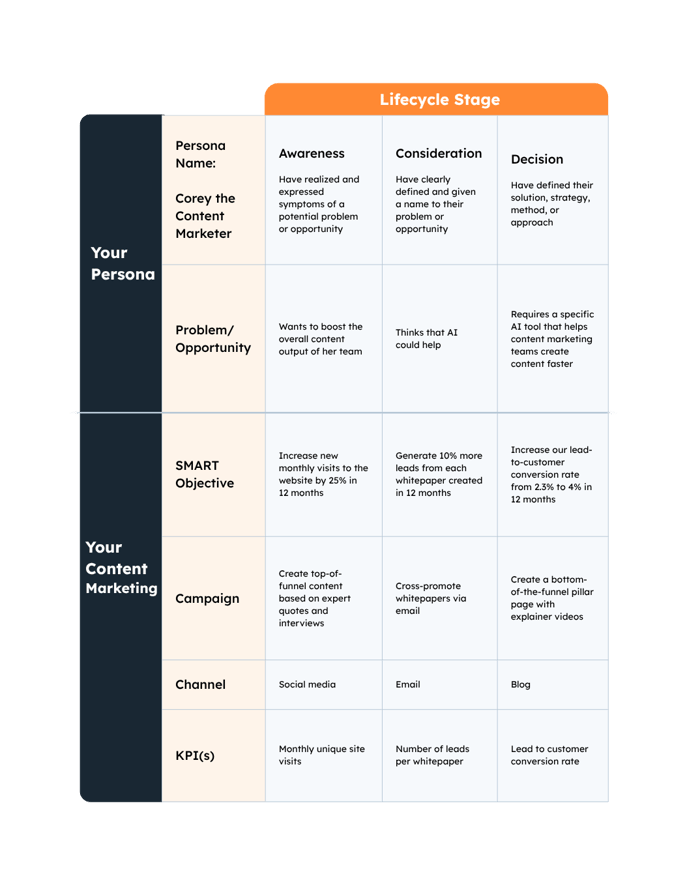
Of course, your goals will vary depending on your buyer persona. It can be helpful to plot on a content map, which breaks down the customer lifecycle for each of your buyer personas. A customer’s lifecycle is their journey from first learning about your company all the way to making a purchase. There are three stages to consider in the process:

OPO-Claude AI Guide-1b

Awareness:

The buyer becomes aware they have a problem.
ChatGPT Image Jun 12, 2025, 11_38_52 AM

Consideration:

The buyer defines their problem and is now considering solutions to it.
OPO-Claude AI Guide-3b

Decision:

The buyer evaluates their options and decides on the best one to solve 
 their problem

How to Create A Content Map

A content map organizes your content marketing strategy across a customer’s lifecycle. If you have multiple buyer personas, you should create a map for each of them. We’ve included three blank templates for you to use in the Content Marketing Planning templates.

Each objective should be a SMART goal, which stands for:

  • Specific: What exactly do we want to achieve, and who will be responsible for it?
  • Measurable: How will we quantify success and measure progress toward this goal (i.e., what KPIs will we measure)?
  • Attainable: Do we have the skills and resources needed to achieve this goal, or can they be obtained?
  • Relevant: How does this goal directly support our broader content marketing objectives?
  • Time-based: What is the deadline for this goal, and what are the key milestones along the way?

Here's an example content map for you to use as inspiration:

Persona Name Corey the Content Marketer

Getting Started With Content Planning

How to Use the Content Marketing Idea Planning Template 

You’ve assessed your current efforts. You’ve created and refined your buyer personas. You’ve set clear SMART goals. Now comes the fun part: planning your future content marketing campaigns with our easy-to-use templates.

The Content Marketing Idea Planning Template is perfect for generating and collecting content ideas. Inside the sheet, you’ll find columns where you can input your title, summary, content type, hook, target persona, goals, and more. You’ll also find a helpful benefit-cost analysis, where you can rank the potential benefit and cost from producing this content and determine whether it’s a worthy investment.

Here are several content types you can potentially plan out for your marketing strategy: 

  • Whitepapers: In-depth, authoritative reports that explore complex topics in detail, ideal for establishing thought leadership and informing decision-makers in B2B contexts. 
  • Ebooks: Digital books that provide comprehensive information on a subject, great for educating audiences and capturing leads through download forms. 
  • Templates: Pre-designed tools or frameworks that help users complete tasks more efficiently, often used to provide practical value and encourage sharing. 
  • Webinars: Live or recorded online seminars that engage audiences through presentations and discussions, valuable for building community and generating leads. 
  • Case studies: Detailed analyses of successful projects or partnerships, used to demonstrate expertise and the practical application of products or services. 
  • Infographics: Visual representations of data or information, effective for quickly conveying complex ideas and boosting shareability on social media. 
  • Blog posts: Short articles published on a website, ideal for driving organic traffic and engaging with audiences on current topics. 
  • Videos: Recorded visual content that can range from short clips to in-depth tutorials, powerful for capturing attention and enhancing engagement across platforms. 
  • Checklists: Simple lists that guide users through tasks or processes, useful for providing quick, actionable value to the audience. 
  • Podcasts: Audio content that explores topics through interviews or storytelling, useful for building a loyal audience and demonstrating expertise in a more personal format.
  • Surveys and reports: Data-driven content that captures and analyzes market or audience insights, useful for supporting claims and influencing industry trends.

It’s important to create a diverse array of content types for your audiences, depending on their lifecycle stage. Consider including a balanced mix of both top-and-bottom-of-the-funnel content.

Screenshot 2025-08-01 at 10.50.52 AM

Mix it up, but make it count. Your content should be as diverse as your audience's journey. From spark-inducing thought pieces that light up awareness to case studies that seal the deal, each piece plays a role in nudging folks forward. The magic? Variety with a purpose—a carefully crafted content lineup that takes your audience on a wild ride from 'who are you?' to 'shut up and take my money.

Drue Stinnett

Senior Demand Generation Manager

Bungii

Here’s how some content types fit into the lifecycle stages of each customer’s journey. Use the tabs to toggle between sections:
  • Blog posts
  • Infographics
  • Videos
  • Podcasts
  • Social media posts
  • Ebooks
  • Webinars
  • Templates
  • Checklists
  • Whitepapers
  • Case studies
  • Surveys and reports

How to Use the Search Engine Optimization (SEO) Template 

The SEO template is a perfect way to track and build out your SEO efforts. In fact, it's exactly what HubSpot's SEO team uses to drive millions of organic traffic to your content. Inside, you'll find columns to input your primary & secondary keywords, monthly search volume (MSV), keyword difficulty (KD), author assignments, image/video instructions, and more. 

amanda sellers

A creative brief is instrumental to the strategic/tactical alignment between strategists and content creators, acting as the hand-off and "in-between" space between strategy and implementation. If the strategy isn't communicated well, it won't be executed well and you won't get the performance outcomes you want from that strategy. Therefore, having a streamlined hand-off (with a clear brief) is necessary for effective content marketing.

Amanda Sellers

Manager, EN Blog Strategy

HubSpot

How to Use the Content Marketing Planning Template

To start creating your campaign timeline using the template, first determine how far in advance you want to plan. On the Content Marketing Campaign Planning template, we dedicated each row to a week of work. But you can reduce this to days or even months depending on the length of your campaign. 

amanda sellers-1

As a content strategist, you should be guiding creators to think about what actions you want your audience to take next. After all, it's not traffic that pays the bills. That way, we canget more out of the traffic we are able to generate.

Amanda Sellers

Manager, EN Blog Strategy

HubSpot

Measuring the Success of Content Marketing Campaigns

Remember those KPIs and SMART goals from earlier? You’ll now use those to measure the success of your content marketing campaigns.

Did you reach attributed revenue goals? Did you increase brand awareness by achieving a certain number of visits to your website? Did you drive the number of leads you were hoping to attain?

If you did, amazing. Pat yourself (and your team) on the back for a job well done. If you didn’t, that’s okay, too. Every campaign, regardless of whether it smashes a goal or falls short of it, can help you improve your future content marketing efforts.

Here are a few ways to extract takeaways from your campaigns:

Pick top-performing content types

  • Does your audience engage most successfully with whitepapers and ebooks? Keep iterating on your previous success and focus on leveraging these successful formats in future campaigns.

Review audience data

  • Take a look through demographic and behavioral data gathered from the campaign to learn more about your buyer personas.

Examine your distribution

  • Sometimes, it’s not the content that falls short but the distribution channel. Examine which platforms and channels drove the most engagement and conversions, and prioritize these for distributing future content.

Refine Content Topics

  • Assess which topics resonated most with your audience and explore related topics for future content.

Analyze timing

  • Did certain days or times result in above-average performance? Analyze your timing data to determine the best days/times to publish and promote content.

Assess your budget distribution

  • Look at the return on investment (ROI) for various parts of the campaign to optimize budget spending.

Collect feedback

  • Sometimes, all you need to do is ask your buyer personas how they felt about your content. Send surveys and seek feedback from them following campaigns.

Set future goals based on benchmark data

  • If you weren’t collecting data before, you now have benchmarks to set realistic future goals.

HubSpot's Content Marketing Software

All-in-one, AI-powered content marketing software that helps marketers create and manage content.

Web Hosting_Linear_llustrations_Characters (1)-1